



CXC Home | Search | Help | Image Use Policy | Latest Images | Privacy | Accessibility | Glossary | Q&A
March 2, 2005
CXC RELEASE: 05-02
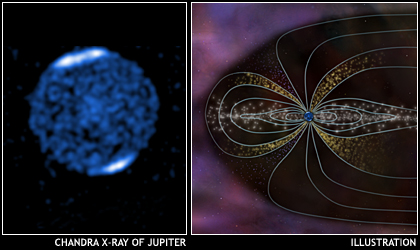
Scientists have obtained new insight into the unique power source for many of Jupiter's auroras, the most spectacular and active auroras in the Solar System. Extended monitoring of the giant planet with NASA's Chandra X-ray Observatory detected the presence of highly charged particles crashing into the atmosphere above its poles.
X-ray spectra measured by Chandra showed that the auroral activity was produced by ions of oxygen and other elements that were stripped of most of their electrons. This implies that these particles were accelerated to high energies in a multimillion-volt environment above the planet's poles. The presence of these energetic ions indicates that the cause of many of Jupiter's auroras is different from auroras produced on Earth or Saturn.
"Spacecraft have not explored the region above the poles of Jupiter, so X-ray observations provide one of the few ways to probe that environment," said Ron Elsner of the NASA Marshall Space Flight Center in Huntsville, Alabama, and lead author on a recently published paper describing these results in the Journal for Geophysical Research. "These results will help scientists to understand the mechanism for the power output from Jupiter's auroras, which are a thousand times more powerful than those on Earth."
Electric voltages of about 10 million volts, and currents of 10 million amps - a hundred times greater than the most powerful lightning bolts - are required to explain the X-ray observations. These voltages would also explain the radio emission from energetic electrons observed near Jupiter by the Ulysses spacecraft.
On Earth, auroras are triggered by solar storms of energetic particles, which disturb Earth's magnetic field. Gusts of particles from the Sun can also produce auroras on Jupiter, but unlike Earth, Jupiter has another way of producing auroras. Jupiter's rapid rotation, intense magnetic field, and an abundant source of particles from its volcanically active moon, Io, create a huge reservoir of electrons and ions. These charged particles, trapped in Jupiter's magnetic field, are continually accelerated down into the atmosphere above the polar regions where they collide with gases to produce the aurora, which are almost always active on Jupiter.
If the particles responsible for the aurora came from the Sun, they should have been accompanied by large number of protons, which would have produced an intense ultraviolet aurora. Hubble ultraviolet observations made during the Chandra monitoring period showed relatively weak ultraviolet flaring. The combined Chandra and Hubble data indicate that this auroral activity was caused by the acceleration of charged ions of oxygen and other elements trapped in the polar magnetic field high above Jupiter's atmosphere.
Chandra observed Jupiter in February 2003 for four rotations of the planet (approximately 40 hours) during intense auroral activity. These Chandra observations, taken with its Advanced CCD Imaging Spectrometer, were accompanied by one-and-a-half hours of Hubble Space Telescope observations at ultraviolet wavelengths.
The research team also included Noe Lugaz, Hunter Waite, and Tariq Majeed (University of Michigan, Ann Arbor), Thomas Cravens (University of Kansas, Lawrence), Randy Gladstone (Southwest Research Institute, San Antonio, Texas), Peter Ford (Massachusetts Institute of Technology, Cambridge), Denis Grodent (University of Liege, Belgium), Anil Bhardwaj (Marshall Space Flight Center) and Robert MacDowell and Michael Desch (Goddard Space Flight Center, Greenbelt, Md.)
NASA's Marshall Space Flight Center, Huntsville, Ala., manages the Chandra program for NASA's Office of Space Science, Washington. Northrop Grumman of Redondo Beach, Calif., formerly TRW, Inc., was the prime development contractor for the observatory. The Smithsonian Astrophysical Observatory controls science and flight operations from the Chandra X-ray Center in Cambridge, Mass.
Additional information and images are available at:
MEDIA CONTACTS
Steve Roy
Marshall Space Flight Center, Huntsville, AL
Phone: 256-544-6535
Megan Watzke
Chandra X-ray Observatory Center, CFA, Cambridge, MA
Phone: 617-496-7998
cxcpress@cfa.harvard.edu


Revised: March 25, 2008