



CXC Home | Search | Help | Image Use Policy | Latest Images | Privacy | Accessibility | Glossary | Q&A
November 22, 2004
CXC RELEASE: 04-12
NASA's Chandra X-ray Observatory has obtained definitive evidence that a distant quasar formed less than a billion years after the Big Bang contains a fully-grown supermassive black hole generating energy at the rate of twenty trillion Suns. The existence of such massive black holes at this early epoch of the Universe challenges theories of the formation of galaxies and supermassive black holes.
Astronomers Daniel Schwartz and Shanil Virani of the Harvard-Smithsonian Center for Astrophysics in Cambridge, MA observed the quasar, known as SDSSp J1306, which is 12.7 billion light years away. Since the Universe is estimated to be 13.7 billion years old, we see the quasar as it was a billion years after the Big Bang. They found that the distribution of X-rays with energy, or X-ray spectrum, is indistinguishable from that of nearby, older quasars. Likewise, the relative brightness at optical and X-ray wavelengths of SDSSp J1306 was similar to that of the nearby group of quasars. Optical observations suggest that the mass of the black hole is about a billion solar masses.
Evidence of another early-epoch supermassive black hole was published previously by a team of scientists from the California Institute of Technology and the United Kingdom using the XMM-Newton X-ray satellite. They observed the quasar SDSSp J1030 at a distance of 12.8 billion light years and found essentially the same result for the X-ray spectrum as the Smithsonian scientists found for SDSSp J1306. Chandra's precise location and spectrum for SDSSp J1306 with nearly the same properties eliminate any lingering uncertainty that precocious supermassive black holes exist.
"These two results seem to indicate that the way supermassive black holes produce X-rays has remained essentially the same from a very early date in the Universe," said Schwartz. "This implies that the central black hole engine in a massive galaxy was formed very soon after the Big Bang."
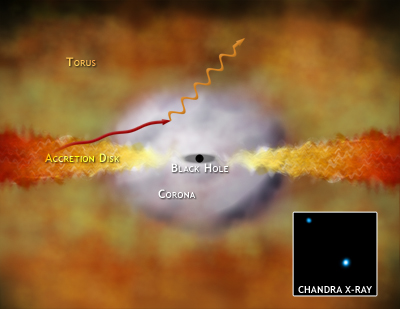
There is general agreement among astronomers that X-radiation from the vicinity of supermassive black holes is produced as gas is pulled toward a black hole, and heated to temperatures ranging from millions to billions of degrees. Most of the infalling gas is concentrated in a rapidly rotating disk, the inner part of which has a hot atmosphere or corona where temperatures can climb to billions of degrees.
Although the precise geometry and details of the X-ray production are not known, observations of numerous quasars, or supermassive black holes, have shown that many of them have very similar X-ray spectra, especially at high X-ray energies. This suggests that the basic geometry and mechanism are the same for these objects.
The remarkable similarity of the X-ray spectra of the young supermassive black holes to those of much older ones means that the supermassive black holes and their accretion disks, were already in place less than a billion years after the Big Bang. One possibility is that millions of 100 solar mass black holes formed from the collapse of massive stars in the young galaxy, and subsequently built up a billion-solar mass black hole in the center of the galaxy through mergers and accretion of gas.
To answer the question of how and when supermassive black holes were formed, astronomers plan to use the very deep Chandra exposures and other surveys to identify and study quasars at even earlier ages.
The paper by Schwartz and Virani on SDSSp J1306 was published in the November 1, 2004 issue of The Astrophysical Journal. The paper by Duncan Farrah and colleagues on SDSS J1030 was published in the August 10, 2004 issue of The Astrophysical Journal.
Chandra observed J1306 with its Advanced CCD Imaging Spectrometer (ACIS) instrument for approximately 33 hours in November 2003. NASA's Marshall Space Flight Center, Huntsville, Ala., manages the Chandra program for NASA's Office of Space Science, Washington. Northrop Grumman of Redondo Beach, Calif., formerly TRW, Inc., was the prime development contractor for the observatory. The Smithsonian Astrophysical Observatory controls science and flight operations from the Chandra X-ray Center in Cambridge, Mass.
Additional information and images are available at:
http://chandra.harvard.edu
and
http://chandra.nasa.gov
http://chandra.harvard.edu
and
http://chandra.nasa.gov
MEDIA CONTACTS
Steve Roy
Marshall Space Flight Center, Huntsville, AL
Phone: 256-544-6535
Megan Watzke
Chandra X-ray Observatory Center, CfA, Cambridge, MA
Phone: 617-496-7998


Revised: March 27, 2008