



CXC Home | Search | Help | Image Use Policy | Latest Images | Privacy | Accessibility | Glossary | Q&A
October 26, 2004
CXC: 04-1
Dark matter continues to confound astronomers, as NASA's Chandra X-ray Observatory demonstrated with the detection of an extensive envelope of dark matter around an isolated elliptical galaxy. This discovery conflicts with optical data that suggest a dearth of dark matter around similar galaxies, and raises questions about how galaxies acquire and keep such dark matter halos.
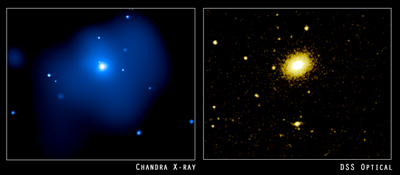
The observed galaxy, known as NGC 4555, is unusual in that it is a fairly large, elliptical galaxy that is not part of a group or cluster of galaxies. In a paper to be published in the November 1, 2004 issue of the Monthly Notices of the Royal Astronomical Society, Ewan O'Sullivan of the Harvard-Smithsonian Center for Astrophysics in Cambridge, MA and Trevor Ponman of the University of Birmingham, United Kingdom, use the Chandra data to show that the galaxy is embedded in a cloud of 10-million-degree-Celsius gas.
This hot gas cloud has a diameter of about 400,000 light years, about twice that of the visible galaxy. An enormous envelope, or halo, of dark matter is needed to confine the hot cloud to the galaxy. The total mass of the dark matter halo is about ten times the combined mass of the stars in the galaxy, and 300 times the mass of the hot gas cloud.
A growing body of evidence indicates that dark matter - which interacts with itself and "normal" matter only through gravity - is the dominant form of matter in the universe. According to the popular "cold dark matter" theory, dark matter consists of mysterious particles left over from the dense early universe that were moving slowly when galaxies and galaxy clusters began to form.
"The observed properties of NGC 4555 confirm that elliptical galaxies can posses dark matter halos of their own, regardless of their environment," said O'Sullivan. "This raises an important question: what determines whether elliptical galaxies have dark matter halos?"
Most large elliptical galaxies are found in groups and clusters of galaxies, and are likely the product of the merger of two spiral galaxies. In such an environment, the dark matter halos can be stripped away by gravitational tidal force and added to other galaxies or the group as a whole. Therefore, it is difficult to determine how much dark matter the original galaxies had, and how much they have lost to the group as a whole through interactions with their environment.
The importance of the issue of the intrinsic amount of dark matter associated with an elliptical galaxy has recently increased owing to a report by an international team of astronomers led by Aaron Romanowsky of the University of Nottingham, United Kingdom. This team found little, if any evidence of dark matter in three relatively nearby elliptical galaxies. Two of these were in loose galaxy groups, and one was isolated. Their result, based on optical data from the 4.2 meter William Herschel Telescope on the Spanish island of La Palma, is in clear conflict with the X-ray data on NGC 4555. The optical technique used to search for dark matter in the nearby elliptical galaxies could not be applied to NGC 4555 because it is more than 3 times as far away from Earth.
Either the galaxies observed by Romanowsky and colleagues have lost their dark matter halos through earlier interactions with other galaxies, or their dark matter halos are much more extended, or they formed without dark matter halos. The first option is possible for the galaxies in groups, but very unlikely for the isolated galaxy. The second and third options are still open, but would require a modification - perhaps a major modification - of the cold dark matter theory of galaxy formation.
"This is clearly a question which deserves further consideration," said O'Sullivan. "It seems likely that much more theoretical and observational work on elliptical galaxies will be required before this issue can be resolved."
Chandra observed NGC 4555 with its Advanced CCD Imaging Spectrometer (ACIS) in February 2003. NASA's Marshall Space Flight Center, Huntsville, Ala., manages the Chandra program for NASA's Office of Space Science, Washington. Northrop Grumman of Redondo Beach, Calif., formerly TRW, Inc., was the prime development contractor for the observatory. The Smithsonian Astrophysical Observatory controls science and flight operations from the Chandra X-ray Center in Cambridge, Mass.
Additional information and images are available at:
MEDIA CONTACTS
Steve Roy
Marshall Space Flight Center, Huntsville, AL
Phone: 256-544-6535
Megan Watzke
Chandra X-ray Observatory Center, CFA, Cambridge, MA
Phone: 617-496-7998
cxcpress@cfa.harvard.edu


Revised: March 27, 2008