



CXC Home | Search | Help | Image Use Policy | Latest Images | Privacy | Accessibility | Glossary | Q&A
September 23, 2004
CXC RELEASE: 04-11
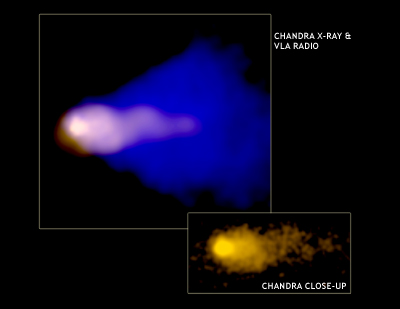
Astronomers have used an X-ray image to make the first detailed study of the behavior of high-energy particles around a fast moving pulsar. The image, from NASA's Chandra X-ray Observatory, shows the shock wave created as a pulsar plows supersonically through interstellar space. These results will provide insight into theories for the production of powerful winds of matter and antimatter by pulsars.
Chandra's image of the glowing cloud, known as the Mouse, shows a stubby bright column of high-energy particles, about four light years in length, swept back by the pulsar's interaction with interstellar gas. The intense source at the head of the X-ray column is the pulsar, estimated to be moving through space at about 1.3 million miles per hour.
A cone-shaped cloud of radio-wave-emitting particles envelopes the X-ray column. The Mouse, a.k.a. G359.23-0.82, was discovered in 1987 by radio astronomers using the National Science Foundation's Very Large Array in New Mexico. It gets its name from its appearance in radio images that show a compact snout, a bulbous body, and a remarkable long, narrow, tail that extends for about 55 light years.
"A few dozen pulsar wind nebulae are known, including the spectacular Crab Nebula, but none have the Mouse's combination of relatively young age and incredibly rapid motion through interstellar space," said Bryan Gaensler of the Harvard-Smithsonian Center for Astrophysics and lead author of a paper on the Mouse that will appear in an upcoming issue of The Astrophysical Journal. "We effectively are seeing a supersonic cosmic wind tunnel, in which we can study the effects of a pulsar's motion on its pulsar wind nebula, and test current theories."
Pulsars are known to be rapidly spinning, highly magnetized neutron stars -- objects so dense that a mass equal to that of the Sun is packed into a diameter of about 12 miles. Their formation is associated with a Type II supernova, the collapse and subsequent explosion of a massive star. The origin of a pulsar's high velocity is not known, but many astrophysicists suspect that it is directly related to the explosive circumstances involved in the birth of the pulsar.
The rapid rotation and strong magnetic field of a pulsar can generate a wind of high-energy matter and antimatter particles that rush out at near the speed of light. These pulsar winds create large, magnetized bubbles of high-energy particles called pulsar wind nebulae. The X-ray and radio data on the Mouse have enabled Gaensler and his colleagues to constrain the properties of the ambient gas, to estimate the velocity of the pulsar, and to analyze the structure of the various shock waves created by the pulsar, the flow of particles away from the pulsar, and the magnetic field in the nebula.
Other members of the research team were Eric van der Swaluw (FOM Institute of Physics, The Netherlands), Fernando Camilo (Columbia Univ., New York), Vicky Kaspi (McGill Univ., Montreal), Frederick K. Baganoff (MIT, Cambridge, Mass.), Farhad Yusef-Zadeh (Northwestern), and Richard Manchester (Australia Telescope National Facility). The pulsar in the Mouse was originally detected by Camilo et al. in 2002 using Australia's Parkes radio telescope. Chandra observed the Mouse on October 23 and 24, 2002.
NASA's Marshall Space Flight Center, Huntsville, Ala., manages the Chandra program for NASA's Office of Space Science, Washington. Northrop Grumman of Redondo Beach, Calif., formerly TRW, Inc., was the prime development contractor for the observatory. The Smithsonian Astrophysical Observatory controls science and flight operations from the Chandra X-ray Center in Cambridge, Mass.
Additional information and images are available at:
MEDIA CONTACTS
Steve Roy
Marshall Space Flight Center, Huntsville, AL
Phone: 256-544-6535
Megan Watzke
Chandra X-ray Observatory Center, CFA, Cambridge, MA
Phone: 617-496-7998
cxcpress@cfa.harvard.edu


Revised: March 24, 2008