



CXC Home | Search | Help | Image Use Policy | Latest Images | Privacy | Accessibility | Glossary | Q&A
May 18, 2004
NASA RELEASE: 04-163
Astronomers have detected and probed dark energy by applying a powerful, new method that uses images of galaxy clusters made by NASA's Chandra X-ray Observatory. The results trace the transition of the expansion of the Universe from a decelerating to an accelerating phase several billion years ago, and give intriguing clues about the nature of dark energy and the fate of the Universe.
"Dark energy is perhaps the biggest mystery in physics," said Steve Allen of the Institute of Astronomy (IoA) at the University of Cambridge in England, and leader of the study. "As such, it is extremely important to make an independent test of its existence and properties."
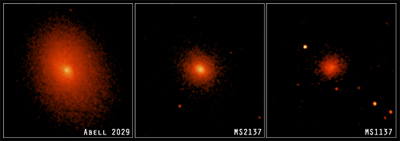
Allen and his colleagues used Chandra to study 26 clusters of galaxies at distances corresponding to light travel times of between one and eight billion years. These data span the time when the Universe slowed from its original expansion, before speeding up again because of the repulsive effect of dark energy.
"We're directly seeing that the expansion of the Universe is accelerating by measuring the distances to these galaxy clusters," said Andy Fabian also of the IoA, a co-author on the study. The new Chandra results suggest that the dark energy density does not change quickly with time and may even be constant, consistent with the "cosmological constant" concept first introduced by Albert Einstein. If so, the Universe is expected to continue expanding forever, so that in many billions of years only a tiny fraction of the known galaxies will be observable.
If the dark energy density is constant, more dramatic fates for the Universe would be avoided. These include the "Big Rip," where dark energy increases until galaxies, stars, planets and eventually atoms are eventually torn apart. The "Big Crunch," where the Universe eventually collapses on itself, would also be ruled out.
Chandra's probe of dark energy relies on the unique ability of X-ray observations to detect and study the hot gas in galaxy clusters. From these data, the ratio of the mass of the hot gas and the mass of the dark matter in a cluster can be determined. The observed values of the gas fraction depend on the assumed distance to the cluster, which in turn depends on the curvature of space and the amount of dark energy in the universe.
Because galaxy clusters are so large, they are thought to represent a fair sample of the matter content in the universe. If so, then relative amounts of hot gas and dark matter should be the same for every cluster. Using this assumption, Allen and colleagues adjusted the distance scale to determine which one fit the data best. These distances show that the expansion of the Universe was first decelerating and then began to accelerate about six billion years ago.
Chandra's observations agree with supernova results including those from the Hubble Space Telescope (HST), which first showed dark energy's effect on the acceleration of the Universe. Chandra's results are completely independent of the supernova technique - both in wavelength and the objects observed. Such independent verification is a cornerstone of science. In this case it helps to dispel any remaining doubts that the supernova technique is flawed.
"Our Chandra method has nothing to do with other techniques, so they're definitely not comparing notes, so to speak," said Robert Schmidt of University of Potsdam in Germany, another coauthor on the study.
Better limits on the amount of dark energy and how it varies with time are obtained by combining the X-ray results with data from NASA's Wilkinson Microwave Anisotropy Probe (WMAP), which used observations of the cosmic microwave background radiation to discover evidence for dark energy in the very early Universe. Using the combined data, Allen and his colleagues found that dark energy makes up about 75% of the Universe, dark matter about 21%, and visible matter about 4%.
Allen and his colleagues stress that the uncertainties in the measurements are such that the data are consistent with dark energy having a constant value. The present Chandra data do, however, allow for the possibility that the dark energy density is increasing with time. More detailed studies with Chandra, HST, WMAP and with the future mission Constellation-X should provide much more precise constraints on dark energy.
"Until we better understand cosmic acceleration and the nature of the dark energy we cannot hope to understand the destiny of the Universe," said independent commentator Michael Turner, of the University of Chicago.
The team conducting the research also included Harald Ebeling of the University of Hawaii and the late Leon van Speybroeck of the Harvard-Smithsonian Center for Astrophysics. These results will appear in an upcoming issue of the Monthly Notices of the Royal Astronomy Society.
NASA's Marshall Space Flight Center, Huntsville, Ala., manages the Chandra program for NASA's Office of Space Science, Washington. Northrop Grumman of Redondo Beach, Calif., formerly TRW, Inc., was the prime development contractor for the observatory. The Smithsonian Astrophysical Observatory controls science and flight operations from the Chandra X-ray Center in Cambridge, Mass.
Additional information and images are available at:
http://chandra.harvard.edu
and
http://chandra.nasa.gov
http://chandra.harvard.edu
and
http://chandra.nasa.gov
MEDIA CONTACTS
Donald Savage
NASA Headquarters, Washington, DC
Phone: 202-358-1727
Steve Roy
Marshall Space Flight Center, Huntsville, AL
Phone: 256-544-6535
Megan Watzke
Chandra X-ray Observatory Center, CFA, Cambridge, MA
Phone: 617-496-7998
cxcpress@cfa.harvard.edu


Revised: December 24, 2009