


CXC Home | Search | Help | Image Use Policy | Latest Images | Privacy | Accessibility | Glossary | Q&A
November 17, 2003
NASA RELEASE: 03-367
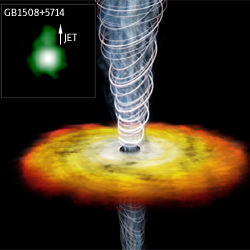
The most distant jet ever observed was discovered in an image of a quasar made by NASA's Chandra X-ray Observatory. Extending more than 100,000 light years from the supermassive black hole powering the quasar, the jet of high-energy particles provides astronomers with information about the intensity of the cosmic microwave background radiation 12 billion years ago.
The discovery of this jet was a surprise to the astronomers, according to team members. Astronomers had previously known the distant quasar GB1508+5714 to be a powerful X-ray source, but there had been no indication of any complex structure or a jet.
"This jet is especially significant because it allows us to probe the cosmic background radiation 1.4 billion years after the Big Bang," said Aneta Siemiginowska of the Harvard-Smithsonian Center for Astrophysics in Cambridge, Mass., lead author of a report on this research in the November 20th Astrophysical Journal Letters. Prior to this discovery, the most distant confirmed X-ray jet corresponded to a time about 3 billion years after the Big Bang.
Quasars are thought to be galaxies that harbor an active central supermassive black hole fueled by infalling gas and stars. This accretion process is often observed to be accompanied by the generation of powerful high-energy jets.
As the electrons in the jet fly away from the quasar at near the speed of light, they move through the sea of cosmic background radiation left over from the hot early phase of the universe. When a fast-moving electron collides with one of these background photons, it can boost the photon's energy up into the X-ray band. The X-ray brightness of the jet depends on the power in the electron beam and the intensity of the background radiation.
"Everyone assumes that the background radiation will change in a predictable way with time, but it is important to have this check on the predictions," said Siemiginowska. "This jet is hopefully just the first in a large sample of these distant objects that can be used to tell us how the intensity of the cosmic microwave background changed over time."
"In fact, if this interpretation is correct, then discovery of this jet is consistent with our previous prediction that X-ray jets can be detected at arbitrarily large distances!" said team member Dan Schwartz, also of the Harvard-Smithsonian Center for Astrophysics.
Chandra originally observed GB1508+5714 with the purpose of studying the X-ray emission from the dust located between the Earth and the far-flung quasar. The jet was found by Siemiginowska and her colleagues when they examined the data once it became available publicly in the Chandra archive.
This led another astronomer to then carefully look at radio observations of the object. Indeed, archived Very Large Array data confirmed the existence of the jet associated with the quasar GB1508+5714. A paper on the radio observations of GB1508+5714 has been accepted by Astrophysical Journal Letters from Teddy Cheung of Brandeis University in Waltham, Mass.
Another group of astronomers led by Weimin Yuan of the University of Cambridge, UK independently reported the discovery of the extended emission in GB1508+5714 in X-rays. In a paper to be published in an upcoming issue of the Monthly Notices of the Royal Astronomical Society, the authors note that significant energy is being deposited in the outer regions of the host galaxy at a very early stage. This energy input could have a profound effect on the evolution of the galaxy by triggering the formation of stars, or inhibiting the growth of the galaxy through accretion of matter from intergalactic space.
NASA's Marshall Space Flight Center, Huntsville, Ala., manages the Chandra program for the Office of Space Science, NASA Headquarters, Washington. Northrop Grumman of Redondo Beach, Calif., formerly TRW, Inc., was the prime development contractor for the observatory. The Smithsonian Astrophysical Observatory controls science and flight operations from the Chandra X-ray Center in Cambridge, Mass.
MEDIA CONTACTS
Don Savage, Public Affairs Office
NASA Headquarters, Washington D.C.
Phone: 202-358-1727
Steve Roy
Marshall Space Flight Center, Huntsville, AL
Phone: 256-544-6535
Megan Watzke
Chandra X-ray Observatory Center, CFA, Cambridge, MA
Phone: 617-496-7998
cxcpress@cfa.harvard.edu


Revised: March 07, 2008