



CXC Home | Search | Help | Image Use Policy | Latest Images | Privacy | Accessibility | Glossary | Q&A
January 6, 2003
RELEASE: 03-002
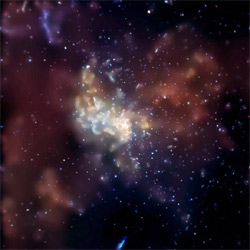
The longest X-ray look yet at the supermassive black hole at the Milky Way's center has given astronomers unprecedented access to its life and times. The new data from NASA's Chandra X-ray Observatory revealed that our galaxy's central black hole is a frequent bad actor, prone to numerous outbursts and occasional large explosions.
The observations of the black hole, a.k.a. Sagittarius A* or Sgr A*, occurred over a two-week period for a total exposure time of 164 hours. During this time Sgr A* flared up in X-ray intensity half a dozen or more times. Astronomers also found evidence that suggests it had an even more boisterous past. These discoveries will help to unlock the secrets of how Sgr A* grows and how it interacts with its environment
"We are getting a look at the everyday life of a supermassive black hole like never before," said Frederick K. Baganoff of the Massachusetts Institute of Technology in Cambridge, who presented these new results on behalf of an international team at a press conference today at the American Astronomical Society meeting in Seattle. "We see it flaring on an almost daily basis."
The cause of the flares is not understood, but the rapidity with which they rise and fall indicates that they are occurring near the event horizon, or point of no return, around the black hole. Even when it flares, the intensity of the X-ray emission from the vicinity of the black hole is relatively weak, which suggests that Sgr A*, weighing in at 3 million times the mass of the Sun, is a starved black hole.
"Although it appears to snack often, this black hole is definitely on a severe diet," says Baganoff. "This could be because explosive events in the past blew away much of the gas from the neighborhood of the black hole."
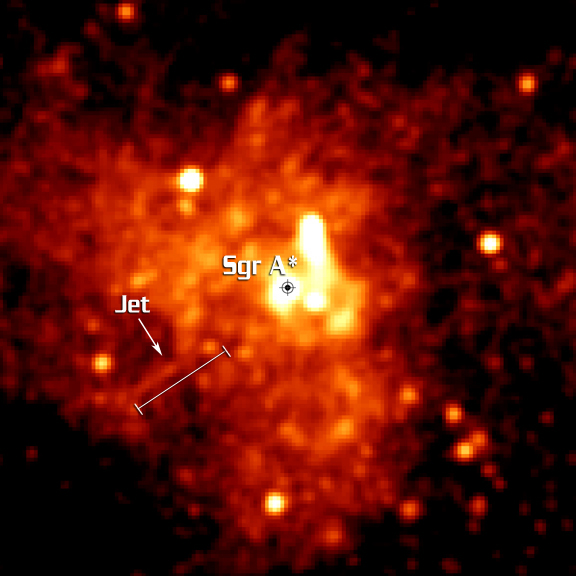
Indeed, evidence for such events - which astronomers are viewing 26,000 years later due to the time it takes light to travel to Earth from the center of the Galaxy - can be found in the image. A faint streak of X-rays about 1 light-year long has been discovered 1.5 light years from Sgr A*. The streak points at Sgr A*, suggesting that it may be a jet of particles expelled at nearly the speed of light from just outside the event horizon of the black hole. The intensity and size of this jet indicate that the flaring activity has been occurring for many years.
On a much larger scale, huge lobes of 20-million-degree-Centigrade gas extending over dozens of light years on either side of the black hole have also been discovered. "These lobes show that enormous explosions have occurred several times over the last ten thousand years," said Mark Morris of UCLA, lead author of a second paper on Sgr A*, who also participated in the press conference.
Sangwook Park, of Penn State University in University Park, and Michael Muno, of MIT, were lead authors of two other papers presented at the meeting. These papers focused on the extraordinarily rich region around the central black hole, where they detected more than 2,000 X-ray sources.
Other members of the team include Mark Bautz and George Ricker of MIT, Niel Brandt, Patrick Broos, George Chartas, Eric Feigelson, Gordon Garmire, and Leisa Townsley of Penn State, Yoshitomo Maeda of the Institute of Space and Astronautical Science in Japan, and Christian Howard of UCLA.
NASA's Marshall Space Flight Center in Huntsville, Ala., manages the Chandra program, and TRW, Inc., Redondo Beach, Calif., is the prime contractor for the spacecraft. The Smithsonian's Chandra X-ray Center controls science and flight operations from Cambridge, Mass., for the Office of Space Science at NASA Headquarters, Washington.
Images and additional information about this result are available at:
MEDIA CONTACTS
Don Savage, Public Affairs Office
NASA Headquarters, Washington D.C.
Phone: 202-358-1727
Steve Roy
Marshall Space Flight Center, Huntsville, AL
Phone: 256-544-6535
Megan Watzke
Chandra X-ray Observatory Center, CfA, Cambridge, MA
Phone: 617-496-7998
cxcpress@cfa.harvard.edu


Revised: March 27, 2008