

CXC Home | Search | Help | Image Use Policy | Latest Images | Privacy | Accessibility | Glossary | Q&A
October 22, 2002
RRELEASE: 02-10
New evidence from NASA's Chandra X-ray Observatory challenges an alternative theory of gravity that eliminates the need for dark matter. The observation also narrows the field for competing forms of dark matter, the elusive material thought to be the dominant form of matter in the universe.
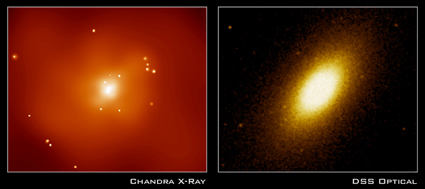
An observation of the galaxy NGC 720 shows it is enveloped in a slightly flattened, or ellipsoidal cloud of hot gas that has an orientation different from that of the optical image of the galaxy. The flattening is too large to be explained by theories in which stars and gas are assumed to contain most of the mass in the galaxy.
"The shape and orientation of the hot gas cloud require it to be confined by an egg-shaped dark matter halo," said David Buote of the University of California, Irvine, and lead author of a report on this research in the 2002 September 20 issue of The Astrophysical Journal. "This means that dark matter is not just an illusion due to a shortcoming of the standard theory of gravity - it is real."
According to the generally accepted standard theory of gravity, the hot X-ray cloud would need an additional source of gravity - a halo of dark matter - to keep the hot gas from expanding away. The mass of dark matter required would be about five to ten times the mass of the stars in the galaxy. If the dark matter tracked the optical light from the stars in the galaxy, the hot X-ray cloud would be more round than it is. The flattened shape of the hot gas cloud requires a flattened dark matter halo.
An alternative theory of gravity called MOND, for Modified Newtonian Dynamics, was proposed in 1983 by Mordecai Milgrom of the Weizmann Institute in Israel, and has remained viable over the years. MOND does away with the need for dark matter by modifying the theory where the acceleration produced by gravity is very small, such as the outskirts of galaxies. However, MOND cannot explain the Chandra observation of NGC 720. This is apparently the first dynamical evidence that has successfully distinguished dark matter from MOND.
The researchers also found that the Chandra data fit predictions of the cold dark matter theories, according to which dark matter consists of slowly moving particles, which interact with each other and "normal" matter only through gravity. Other forms of dark matter, such as self-interacting dark matter, and cold molecular dark matter, are not consistent with the observation in that they require a dark matter halo that is too round or too flat, respectively.
"Chandra's ability to precisely identify and locate the point-like sources contaminating the diffuse emission in the X-ray image was absolutely essential," said Buote. "Only then could we make accurate measurements of the shape and orientation of the X-ray image contours."
The conclusion from the Chandra data that NGC 720 possesses a dark matter halo assumes that the hot gas cloud has not been unduly disturbed by collisions or mergers with other galaxies in the last 100 million years. The lack of evidence of such activity indicates that this assumption is valid.
Chandra observed NGC 720, which is about 80 million light years from Earth, for 11 hours with the Advanced CCD Imaging Spectrometer (ACIS). Other members of the team include Tesla Jeltema and Claude Canizares of Massachusetts Institute of Technology (MIT) in Cambridge, and Gordon Garmire of Pennsylvania State University in University Park. Penn State and MIT developed the instrument for NASA.
NASA's Marshall Space Flight Center in Huntsville, Ala., manages the Chandra program, and TRW, Inc., Redondo Beach, Calif., is the prime contractor for the spacecraft. The Smithsonian's Chandra X-ray Center controls science and flight operations from Cambridge, Mass.
MEDIA CONTACTS
Steve Roy
Marshall Space Flight Center, Huntsville, AL
Phone: 256-544-6535
Megan Watzke
Chandra X-ray Observatory Center, CfA, Cambridge, MA
Phone: 617-496-7998
cxcpress@cfa.harvard.edu


Revised: March 31, 2008