

CXC Home | Search | Help | Image Use Policy | Latest Images | Privacy | Accessibility | Glossary | Q&A
September 19, 2002
RELEASE: 02-178
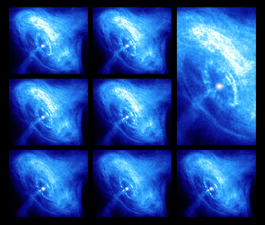
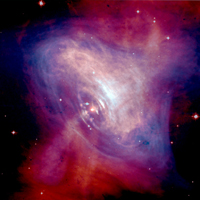
Just when it seemed like the summer movie season had ended, two of NASA's Great Observatories have produced their own action movie. Multiple observations made over several months with NASA's Chandra X-ray Observatory and the Hubble Space Telescope captured the spectacle of matter and antimatter propelled to near the speed of light by the Crab pulsar, a rapidly rotating neutron star the size of Manhattan.
"Through this movie, the Crab Nebula has come to life," said Jeff Hester of Arizona State University in Tempe, lead author of a paper in the September 20th issue of The Astrophysical Journal Letters. "We can see how this awesome cosmic generator actually works."
The Crab was first observed by Chinese astronomers in 1054 A.D. and has since become one of the most studied objects in the sky. By combining the power of both Chandra and Hubble, the movie reveals features never seen in still images. By understanding the Crab, astronomers hope to unlock the secrets of how similar objects across the universe are powered.
Bright wisps can be seen moving outward at half the speed of light to form an expanding ring that is visible in both X-ray and optical images. These wisps appear to originate from a shock wave that shows up as an inner X-ray ring. This ring consists of about two dozen knots that form, brighten and fade, jitter around, and occasionally undergo outbursts that give rise to expanding clouds of particles, but remain in roughly the same location.
"These data leave little doubt that the inner X-ray ring is the location of the shock wave that turns the high-speed wind from the pulsar into extremely energetic particles," said Koji Mori of Penn State University in University Park, a coauthor of the paper.
Another dramatic feature of the movie is a turbulent jet that lies perpendicular to the inner and outer rings. Violent internal motions are obvious, as is a slow motion outward into the surrounding nebula of particles and magnetic field.
"The jet looks like steam from a high pressure boiler," said David Burrows of Penn State, another coauthor of the paper. "Except when you realize you are looking at a stream of matter and anti-matter electrons moving at half the speed of light!"
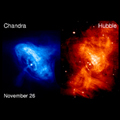
The inner region of the Crab Nebula around the pulsar was observed with Hubble on 24 occasions between August 2000 and April 2001 at 11-day intervals, and with Chandra on eight occasions between November 2000 and April 2001. The Crab was observed with Chandra's Advanced CCD Imaging Spectrometer and Hubble's Wide-Field Planetary Camera.
NASA's Marshall Space Flight Center in Huntsville, Ala., manages the Chandra program, and TRW, Inc., Redondo Beach, Calif., is the prime contractor. The Smithsonian's Chandra X-ray Center controls science and flight operations from Cambridge, Mass. The Space Telescope Science Institute is operated by the Association of Universities for Research in Astronomy, Inc. (AURA), for NASA, under contract with the Goddard Space Flight Center, Greenbelt, Md. The Hubble Space Telescope is a project of international cooperation between NASA and the European Space Agency (ESA).
MEDIA CONTACTS
Dolores Beasley
Headquarters, Washington
Phone: 202-358-1753
Steve Roy
Marshall Space Flight Center, Huntsville, AL
Phone: 256-544-6535
Megan Watzke
Chandra X-ray Observatory Center, CfA, Cambridge, MA
Phone: 617-496-7998
cxcpress@cfa.harvard.edu


Revised: December 23, 2009