

CXC Home | Search | Help | Image Use Policy | Latest Images | Privacy | Accessibility | Glossary | Q&A
February 6, 2002
CXC PR: 02-02
Two discoveries from a distant quasar - an enormous X-ray jet and an X-ray shadow cast by an intervening galaxy - are giving astronomers using NASA's Chandra X-ray Observatory cause to be doubly excited. These two independent results reveal information about a supermassive black hole at the center of the quasar as well as the amount of oxygen in a distant galaxy billions of years ago.
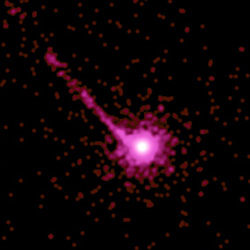
In one set of Chandra observations of quasar PKS 1127-145, researchers found an X-ray jet that extends over a length of at least a million light years. The jet reveals explosive activity that occurred 10 billion years ago around the quasar's central supermassive black hole.
"The X-rays from the jet are likely due to the collision of microwave photons left over from the Big Bang with a high-energy beam of particles," said Aneta Siemiginowska of the Harvard-Smithsonian Center for Astrophysics in Cambridge, MA, lead author on a paper which will appear in the May 10, 2002 issue of the Astrophysical Journal. "The intensity of these microwaves today is much less than it was 10 billion years ago, due to the expansion of the universe."
Chandra observations of quasar PKS 1127-145 demonstrate that scientists can image these jets even though they are billions of light years away. Studies of these extraordinarily large structures will allow astronomers to test models for quasars and the supermassive black holes that power them.
The length of the jet and the prominent knots of X-ray emission observed suggest that the activity in the vicinity of the central supermassive black hole is long-lived but maybe intermittent, perhaps due to the mergers of other galaxies with the host galaxy.
In a separate result obtained by studying the same quasar, scientists found an X-ray shadow cast by an intervening galaxy. On their way to Earth, the X-rays from PKS 1127-145 pass through a galaxy located about 4 billion light years from Earth, which gives astronomers information about the amount of oxygen in the galaxy at that time.
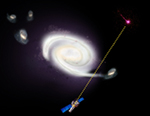
PKS 1127-145 Absorber Illustration
Credit: NASA/CXC/M.Weiss
Atoms of various elements in this galaxy absorb some of the X-rays, yielding a dimming of the quasar's X-rays. In a similar way, when our body is X-rayed, our bones produce an X-ray shadow. In this case, the quasar acts as the X-ray machine. By measuring the amount of absorption, astronomers were able to estimate that the intervening galaxy contained only about 20 percent as much oxygen as our Milky Way Galaxy has now. These observations will give astronomers insight into how the oxygen supply of galaxies is built up over the eons.
"We are looking at a galaxy at about the time in the history of the universe when our Sun formed," said Jill Bechtold of the University of Arizona, the lead author on another paper in the November 20, 2001 issue of The Astrophysical Journal that describes these results. "It's intriguing that this galaxy had only about 1/5 of the oxygen that we now measure for typical stars in our Galaxy."
Scientists believe that elements such as oxygen, silicon and sulfur are dispersed into the galaxy primarily by the explosion of massive stars. As galaxies age, they become more enriched in oxygen and other elements necessary for life. Using the fact that the light travel time from distant galaxies can range from hundreds of millions to billions of years, astronomers can study the rate of this enrichment.
"X-ray observations are especially important for this study," emphasized Bechtold. "They provide a direct measurement of the abundance of oxygen atoms without the complications of dust and other factors that make the interpretation of optical and ultraviolet observations difficult."
Other members of the research teams were Thomas Aldcroft, Martin Elvis, Dan Harris and Adam Dobrzycki (Harvard-Smithsonian Center for Astrophysics). The Advanced CCD Imaging Spectrometer (ACIS) X-ray camera, which was used in both observations, was developed for NASA by Pennsylvania State University, University Park, PA, and the Massachusetts Institute of Technology, Cambridge, MA. NASA's Marshall Space Flight Center in Huntsville, AL, manages the Chandra program. TRW, Inc., Redondo Beach, California, is the prime contractor for the spacecraft. The Smithsonian's Chandra X-ray Center controls science and flight operations from Cambridge, MA.
MEDIA CONTACTS
Steve Roy
Marshall Space Flight Center, Huntsville, AL
Phone: 256-544-6535
Megan Watzke
Chandra X-ray Observatory Center, CfA, Cambridge, MA
Phone: 617-496-7998


Revised: March 07, 2008