

CXC Home | Search | Help | Image Use Policy | Latest Images | Privacy | Accessibility | Glossary | Q&A
January 8, 2002
RELEASE: 02-02
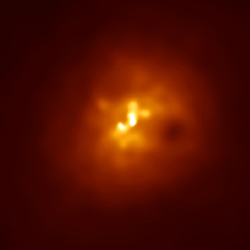
"Ghostly" relics of an ancient eruption that tore through a cluster of galaxies were recently uncovered by NASA's Chandra X-ray Observatory. The discovery implies that galaxy clusters are the sites of enormously energetic and recurring explosions, and may provide an explanation why galaxy clusters behave like giant cosmic magnets.
"Chandra's image revealed vast regions in the galaxy cluster Abell 2597 that contain almost no X-ray or radio emission. We call them ghost cavities," said Brian McNamara of Ohio University in Athens today during a press conference at the American Astronomical Society meeting in Washington. "They appear to be remnants of an old explosion where the radio emission has faded away over millions of years."
The ghost cavities were likely created by extremely powerful explosions, due to material falling toward a black hole millions of times more massive than the Sun. As the matter swirled around the black hole, located in a galaxy near the center of the cluster, it generated enormous electromagnetic fields that expelled material from the vicinity of the black hole at high speeds.
This explosive activity in Abell 2597 created jets of highly energetic particles that cleared out voids in the hot gas. Because they are lighter than the surrounding material, the cavities will eventually push their way to the edge of the cluster, just as air bubbles in water make their way to the surface.
Researchers also found evidence that this explosion was not a one-time event. "We detected a small, bright radio source near the center of the cluster that indicates a new explosion has occurred recently," said team member Michael Wise of the Massachusetts Institute of Technology in Cambridge, "so the cycle of eruption is apparently continuing."
Though dim, the ghost cavities are not completely empty. They contain a mixture of very hot gas, high-energy particles and magnetic fields -- otherwise the cavities would have collapsed under the pressure of the surrounding hot gas.
"Ghost cavities may be the vessels that transport magnetic fields generated in a disk surrounding a giant black hole to the cluster gas that is spread over a region a billion times larger," said McNamara. If dozens of these cavities were created over the life of the cluster, they could explain the surprisingly strong magnetic field of the multimillion-degree gas that pervades the cluster.
Galaxy clusters are the largest known gravitationally bound structures in the universe. Hundreds of galaxies swarm in giant reservoirs of multimillion-degree gas that radiates most of its energy in X-rays. Over the course of billions of years some of the gas should cool and sink toward a galaxy in the center of the cluster where it could trigger an outburst in the vicinity of the central massive black hole.
Chandra observed Abell 2597 on July 28, 2000,for 40,000 seconds with the Advanced CCD Imaging Spectrometer (ACIS) instrument. Pennsylvania State University, University Park, and MIT developed the instrument for NASA. In addition to a group of astronomers from the Space Telescope Science Institute, Baltimore, and the University of Virginia, Charlottesville, the team included: Paul Nulsen, University of Wollagong, Australia; Larry David, Harvard-Smithsonian Center for Astrophysics, Cambridge, Mass.; Chris Carilli, National Radio Astronomy Observatory, Socorro, N.M.; and Craig Sarazin, University of Virginia.
NASA's Marshall Space Flight Center in Huntsville, Ala., manages the Chandra program, and TRW, Inc., Redondo Beach, Calif., is the prime contractor for the spacecraft. The Smithsonian's Chandra X-ray Center controls science and flight operations from Cambridge, Mass.
MEDIA CONTACTS
Dolores Beasley
Headquarters, Washington, DC
Phone: 202-358-1753
Steve Roy
Marshall Space Flight Center, Huntsville, AL
Phone: 256-544-6535
Megan Watzke
Chandra X-ray Observatory Center, CfA, Cambridge, MA
Phone: 617-496-7998


Revised: March 31, 2008