

CXC Home | Search | Help | Image Use Policy | Latest Images | Privacy | Accessibility | Glossary | Q&A
February 15, 2001
CXC PR: 01-04
The most distant X-ray cluster of galaxies yet has been found by astronomers using NASA’s Chandra X-ray Observatory. Approximately 10 billion light years from Earth, the cluster 3C294 is 40 percent farther than the next most distant X-ray galaxy cluster. The existence of such a distant galaxy cluster is important for understanding how the universe evolved.
"Distant objects like 3C294 provide snapshots to how these galaxy clusters looked billions of years ago," said Andrew Fabian of the Institute of Astronomy, Cambridge, England and lead author of the paper accepted for publication in the Monthly Notices of Britain’s Royal Astronomical Society. "These latest results help us better understand what the universe was like when it was only 20 percent of its current age."
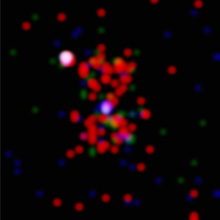
Chandra’s image reveals an hourglass-shaped region of X-ray emission centered on the previously known central radio source. This X-ray emission extends outward from the central galaxy for at least 300,000 light years and shows that the known radio source is in the central galaxy of a massive cluster.
Scientists have long suspected that distant radio-emitting galaxies like 3C294 are part of larger groups of galaxies known as "clusters." However, radio data provides astronomers with only a partial picture of these distant objects. Confirmation of the existence of clusters at great distances – and, hence, at early stages of the universe – requires information from other wavelengths. Optical observations can be used to pinpoint individual galaxies, but X-ray data are needed to detect the hot gas that fills the space within the cluster.
"Galaxy clusters are the largest gravitationally bound structures in the universe," said Fabian. "We do not expect to find many massive objects, such as the 3C294 cluster, in early times because structure is thought to grow from small scales to large scales."
The vast clouds of hot gas that envelope galaxies in clusters are thought to be heated by collapse toward the center of the cluster. Until Chandra, X-ray telescopes have not had the needed sensitivity to identify and measure hot gas clouds in distant clusters.
Carolin Crawford, Stefano Ettori and Jeremy Sanders of the Institute of Astronomy were also members of the team that observed 3C294 for 5.4 hours on October 29, 2000 with the Advanced CCD Imaging Spectrometer (ACIS).
The ACIS X-ray camera was developed for NASA by Pennsylvania State University and Massachusetts Institute of Technology. NASA's Marshall Space Flight Center in Huntsville, AL, manages the Chandra program for the Office of Space Science in Washington, DC. The Smithsonian's Chandra X-ray Center controls science and flight operations from Cambridge, MA.
Images associated with this release are available on the World Wide Web at:
MEDIA CONTACTS
Steve Roy
Marshall Space Flight Center, Huntsville, AL
Phone: 256-544-6535
Megan Watzke
Chandra X-ray Observatory Center, CfA, Cambridge, MA
Phone: 617-496-7998


Revised: March 27, 2008