

CXC Home | Search | Help | Image Use Policy | Latest Images | Privacy | Accessibility | Glossary | Q&A
May 11, 2000
CXC PR: 00-11
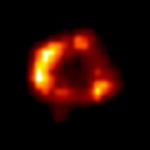
Two images made by NASA's Chandra X-ray Observatory, one in October 1999, the other in January 2000, show for the first time the full impact of the actual blast wave from Supernova 1987A (SN1987A). The observations are the first time that X-rays from a shock wave have been imaged at such an early stage of a supernova explosion.
Recent observations of SN 1987A with the Hubble Space Telescope revealed gradually brightening hot spots from a ring of matter ejected by the star thousands of years before it exploded. Chandra's X-ray images show the cause for this brightening ring. A shock wave is smashing into portions of the ring at a speed of 10 million miles per hour (4,500 kilometers per second). The gas behind the shock wave has a temperature of about ten million degrees Celsius, and is visible only with an X-ray telescope.
"With Hubble we heard the whistle from the oncoming train," said David Burrows of Pennsylvania State University, University Park, the leader of the team of scientists involved in analyzing the Chandra data on SN 1987A. "Now, with Chandra, we can see the train."
The X-ray observations appear to confirm the general outlines of a model developed by team member Richard McCray of the University of Colorado, Boulder, and others, which holds that a shock wave has been moving out ahead of the debris expelled by the explosion. As this shock wave collides with material outside the ring, it heats it to millions of degrees. "We are witnessing the birth of a supernova remnant for the first time," McCray said.
The Chandra images clearly show the previously unseen, shock-heated matter just inside the optical ring. Comparison with observations made with Chandra in October and January, and with Hubble in February 2000, show that the X-ray emission peaks close to the newly discovered optical hot spots, and indicate that the wave is beginning to hit the ring.
In the next few years, the shock wave will light up still more material in the ring, and an inward moving, or reverse, shock wave will heat the material ejected in the explosion itself. "The supernova is digging up its own past," said McCray.
The observations were made on October 6, 1999, using the Advanced CCD Imaging Spectrometer (ACIS) and the High Energy Transmission Grating, and again on January 17, 2000, using ACIS. Other members of the team were Eli Michael of the University of Colorado; Dr. Una Hwang, Dr. Steven Holt and Dr. Rob Petre of NASA's Goddard Space Flight Center in Greenbelt, MD; Professor Roger Chevalier of the University of Virginia, Charlottesville; and Professors Gordon Garmire and John Nousek of Pennsylvania State University. The results will be published in an upcoming issue of the Astrophysical Journal.
The ACIS instrument was built for NASA by the Massachusetts Institute of Technology, Cambridge, and Pennsylvania State University. The High Energy Transmission Grating was built by the Massachusetts Institute of Technology. NASA's Marshall Space Flight Center in Huntsville, AL, manages the Chandra program. TRW, Inc., Redondo Beach, CA, is the prime contractor for the spacecraft. The Smithsonian's Chandra X-ray Center controls science and flight operations from Cambridge, MA.
More About SN 1987AImages to illustrate this release and more information on Chandra's progress can be found on the Internet at:
http://chandra.harvard.edu/photo/2000/sn1987a/index.html
AND
http://chandra.nasa.gov
More About SN 1987A
AND
http://chandra.nasa.gov
More About SN 1987A
MEDIA CONTACTS
Dolores Beasley
Headquarters, Washington, DC
Phone: 202/358-1753
Steve Roy
Marshall Space Flight Center, Huntsville, AL
Phone: 256-544-6535
http://www.nasa.gov/centers/marshall/news
Dr. Wallace Tucker
Chandra X-ray Observatory Center
Harvard-Smithsonian Center for Astrophysics, Cambridge, MA
Phone: 617-496-7998


Revised: December 16, 2014