

CXC Home | Search | Help | Image Use Policy | Latest Images | Privacy | Accessibility | Glossary | Q&A
January 14, 2000
CXC PR: 00-02
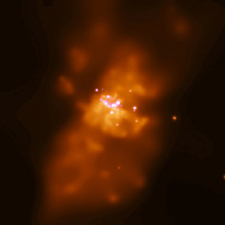
NASA's Chandra X-ray Observatory has imaged the core of the nearest starburst galaxy, Messier 82 (M82). The observatory has revealed a seething cauldron of exploding stars, neutron stars, black holes, 100 million degree gas, and a powerful galactic wind.
The discovery will be presented by a team of scientists from Carnegie Mellon University, Pittsburgh, Penn., Pennsylvania State University, University Park, and the University of Michigan, Ann Arbor, on January 14 at the 195th national meeting of the American Astronomical Society.
"In the disk of our Milky Way Galaxy, stars form and die in a relatively calm fashion like burning embers in a campfire," said Richard Griffiths, Professor of Astrophysics at Carnegie Mellon University. "But in a starburst galaxy, star birth and death are more like explosions in a fireworks factory."
Short-lived massive stars in a starburst galaxy produce supernova explosions, which heat the interstellar gas to millions of degrees, and leave behind neutron stars and black holes. These explosions emit light in the X rays rather than in visible light.
Because the superhot components inside starburst galaxies are complex and sometimes confusing, astronomers need an X-ray-detecting telescope with the highest focusing power (spatial resolution) to clearly discriminate the various structures.
"NASA's Chandra X-ray Observatory is the perfect tool for studying starburst galaxies since it has the critical combination of high-resolution optics and good sensitivity to penetrating X rays," said Gordon Garmire, the Evan Pugh Professor of Astronomy and Astrophysics at Pennsylvania State University, and head of the team that conceived and built Chandra's Advanced CCD Imaging Spectrograph (ACIS) X-ray camera, which acquired the data.
Many intricate structures missed by earlier satellite observatories are now visible in the ACIS image, including more than twenty powerful X-ray binary systems that contain a normal star in a close orbit around a neutron star or a black hole. "Several sources are so bright that they are probably black holes, perhaps left over from past starburst episodes," Garmire explained.
The astronomers report that the X-ray emitting gas in the galaxy's core region has a surprisingly hot temperature. "Determining the source of high-energy X rays from M82 may elucidate whether starburst galaxies throughout the universe contribute significantly to the X-ray background radiation that pervades intergalactic space," said Griffiths."The image also shows a chimney-like structure at the base of the galactic wind, which may help us understand how metal-rich starburst gas is dispersed into intergalactic space."
"What we don't see may be as important as what we do see," said Garmire. "There is no indication of a single, high luminosity, compact X-ray source from a supermassive black hole at the very center of the galaxy, although considerable evidence exists that such central black holes are present in many or most galaxies.".
The astronomers note that recent optical and infrared data suggest most galaxies were starbursts when the universe was young and that their galactic winds may have distributed carbon, oxygen, iron and other heavy atoms that now pervade the Universe. The starburst in M82 is thought to have been caused by a near collision with a large spiral galaxy, M81, about 100 million years ago. At a distance of 11 million light years, M82 is the closest starburst galaxy to our Milky Way Galaxy and provides the best view of this type of galactic structure, which may have played a critical role in the early history of the Universe.
The Chandra image was taken with the Advanced CCD Imaging Spectrometer (ACIS) on September 20, 1999 in an observation that lasted about 13 ½ hours. ACIS was built by Penn State Univ. and Massachusetts Institute of Technology, Cambridge.
To follow Chandra's progress or download images visit the Chandra sites at:
NASA's Marshall Space Flight Center in Huntsville, Ala., manages the Chandra program. TRW, Inc., Redondo Beach, CA, is the prime contractor for the spacecraft. The Smithsonian's Chandra X-ray Center controls science and flight operations from Cambridge, MA.
High resolution digital versions of the X-ray image (JPG, 300 dpi TIFF) are available at the Internet site listed above.
MEDIA CONTACTS
Steve Roy
Marshall Space Flight Center, Huntsville, AL
Phone: 256-544-6535
Barbara Kennedy
Penn State PIO, University Park, PA
Phone: 814-863-4682
Dr. Wallace Tucker
Chandra X-ray Observatory Center, CfA, Cambridge, MA
Phone: 617-496-7998
Teresa Thomas
Carnegie Mellon University PIO, Pittsburgh, PA
412-268-3580


Revised: March 24, 2008