





CXC Home | Search | Help | Image Use Policy | Latest Images | Privacy | Accessibility | Glossary | Q&A
Download Image
More Information
More Images
Related Images
NGC 5315:
When Serendipity Becomes Science

When Serendipity Becomes Science
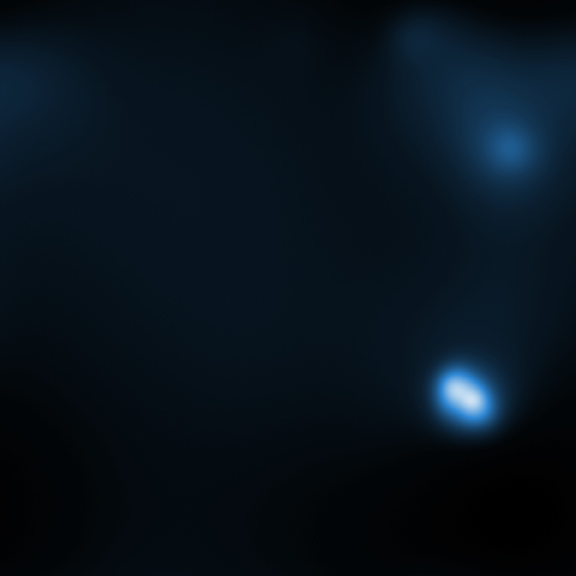
NGC 5315 is a planetary nebula about 7,000 light years from Earth in the constellation of Circinus. Planetary nebulas are gaseous clouds that are created in the last stages of the lifetime of a star like the Sun. The name of "planetary nebula" is a misnomer, since these objects have nothing to do with planets. But the term was born because these objects look like planets when viewed through small optical telescopes. Chandra does not always see planetary nebulas in X-ray light. Rather, they may only become X-ray sources, like NGC 5315, when powerful winds from a particularly young star at the center collide with the ejected material.
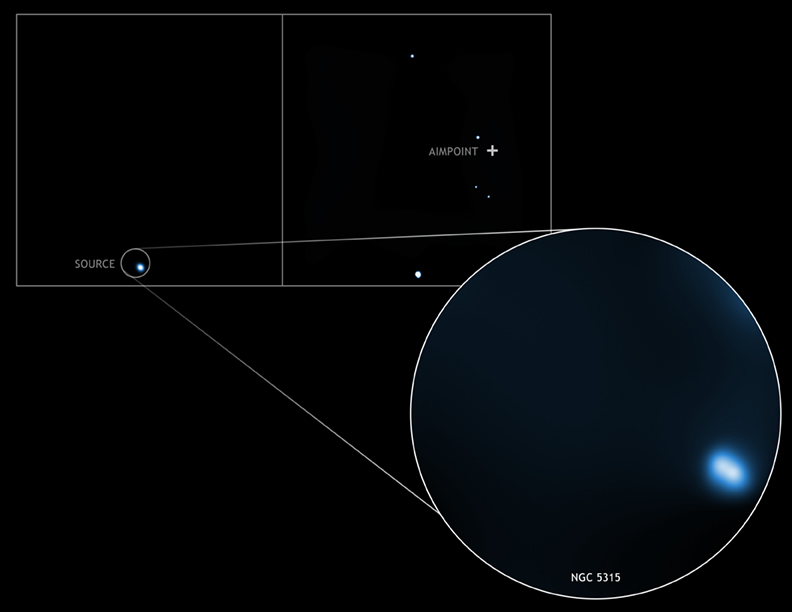
This image of NGC 5315 shows the box-shaped outlines for two of the detectors on Chandra, plus the so-called aimpoint of the telescope, where the Chandra images are the sharpest (the spatial resolution of Chandra images, like those for other X-ray telescopes, descreases with distance from the aimpoint). For optimal imaging of Hen 2-99, Chandra was pointed so that this planetary nebula would fall near the aimpoint. Although Hen 2-99 was too faint to be detected, the planetary nebula NGC 5315 was serendipitously detected a large distance away from the aimpoint, where the image is not as sharp.
|
||||||||||||||||||||||||||||
Visual Description:
The Chandra X-ray Observatory image of the planetary nebula NGC 5315 features a black background with a 2 panel white box in the upper left. A circle of dark blue with a bright blue small bi-lobed blob is pulled out of the two panel, towards the lower right. Planetary nebulas are gaseous clouds that are created in the last stages of the lifetime of a star like the Sun. This image of NGC 5315 shows the box-shaped outlines for two of the detectors on Chandra, plus the aimpoint of the telescope, where the Chandra images are the sharpest (the spatial resolution of Chandra images, like those for other X-ray telescopes, decreases with distance from the aimpoint). For optimal imaging of another planetary nebula, Hen 2-99, Chandra was pointed so that this planetary nebula would fall near the aimpoint. Although Hen 2-99 was too faint to be detected, the planetary nebula NGC 5315 was serendipitously detected a large distance away from the aimpoint, where the image is not as sharp.


Revised: September 03, 2025