







CXC Home | Search | Help | Image Use Policy | Latest Images | Privacy | Accessibility | Glossary | Q&A
Download Image
More Information
More Images
Chandra X-ray Image of
G292.0+1.8
G292.0+1.8
(Credit: NASA/CXC/Penn State/S.Park et al.)
Animation & Video
More Releases


Related Images
G292.0+1.8:
Stellar Forensics with Striking Image from Chandra

Stellar Forensics with Striking Image from Chandra
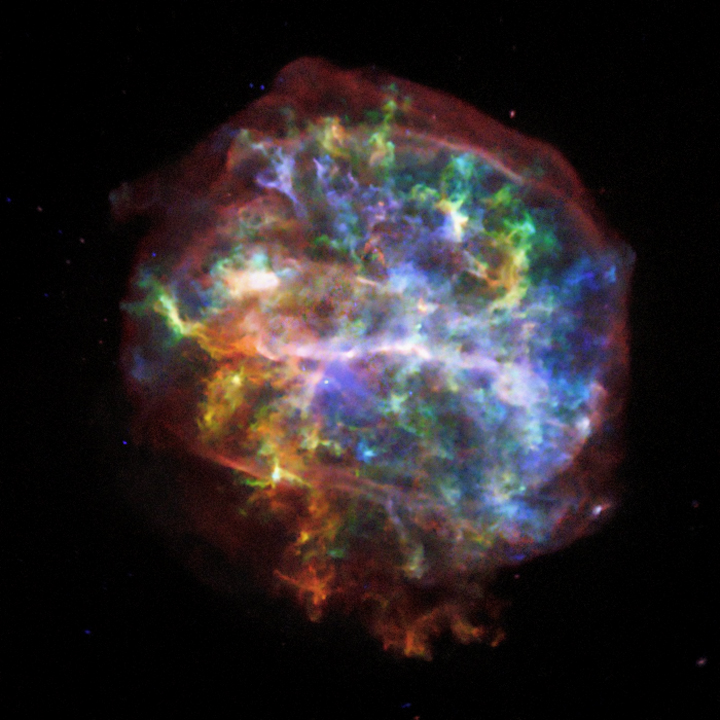
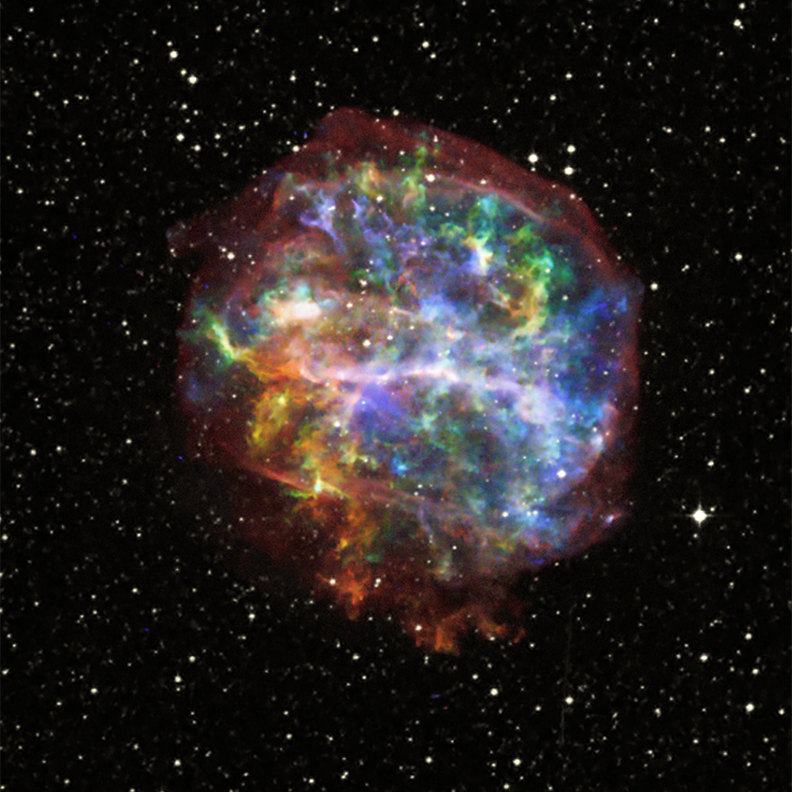
The aftermath of the death of a massive star is shown in beautiful detail in this new composite image of G292.0+1.8. In color is the Chandra X-ray Observatory image — easily the deepest X-ray image ever obtained of this supernova remnant — and in white is optical data from the Digitized Sky Survey. Although considered a "textbook" case of a supernova remnant, the intricate structure shown here reveals a few surprises.
Near the center of G292.0+1.8 is the so-called pulsar wind nebula, most easily seen in high energy X-rays. This is the magnetized bubble of high-energy particles that surrounds the "pulsar", a rapidly rotating neutron star that remained behind after the original, massive star exploded. The narrow, jet-like feature running from north to south in the image is likely parallel to the spin axis of the pulsar.
The pulsar is located slightly below and to the left of the center of G292.0+1.8. Assuming that the pulsar was born at the center of the remnant, it is thought that recoil from the lopsided explosion may have kicked the pulsar in this direction. However, the kick direction and the pulsar spin direction do not appear to be aligned, in contrast to apparent spin-kick alignments seen in some other supernova remnants.
Another key feature of this remnant is the long white line running from left to right across the center called the equatorial belt. This structure is thought to be created when the star — before it died — expelled material from around its equator via winds. The orientation of the equatorial belt suggests the parent star maintained the same spin axis both before and after it exploded.
One puzzling aspect of the image is the lack of evidence for thin filaments of high energy X-ray emission, thought to be an important site for cosmic ray acceleration in supernova remnants. These filaments are seen in other supernova remnants such as Cassiopeia A, Tycho and Kepler. One explanation may be that efficient acceleration occurs primarily in very early stages of supernova remnant evolution, and G292.0+1.8, with an estimated age of several thousand years, is too old to show these effects. Casseiopeia A, Tycho and Kepler, with ages of several hundred years, are much younger.
|
||||||||||||||||||||||||||||
Visual Description:
The Chandra X-ray Observatory image of the supernova remnant G292.0+1.8 features a vibrant, multi-colored nebula on a background of bright stars in optical light from the Digitized Sky Survey. The nebula appears as a large, glowing object in the center of the image, resembling a colorful balloon or blowfish. The colors within the nebula range from shades of blue, green, orange and red. The aftermath of the death of a massive star is shown in beautiful detail in this image. Near the center of G292 is a pulsar wind nebula, in blue. This is the magnetized bubble of high-energy particles that surrounds the pulsar, a rapidly rotating neutron star that remained behind after the original, massive star exploded. A narrow, jet-like feature running from north to south in the image is likely parallel to the spin axis of the pulsar. The pulsar is located slightly below and to the left of the center of G292. Assuming that the pulsar was born at the center of the remnant, it is thought that recoil from the lopsided explosion may have kicked the pulsar in this direction. However, the kick direction and the pulsar spin direction do not appear to be aligned, in contrast to apparent spin-kick alignments seen in some other supernova remnants. Another key feature of this remnant is a long white line running from left to right across the center called the equatorial belt. This structure is thought to be created when the star — before it died — expelled material from around its equator via winds.


Revised: September 03, 2025