
Chandra X-ray Observatory - HomeAbout The ChandraEducational MaterialsField GuidePhoto AlbumPress RoomResources
Chandra X-ray Observatory - HomeChandra Photo Album - You are here
ObservatoryImages by DateImages by CategorySky MapConstellationsSpecial FeaturesChandra Zoom-insImage HandoutsScale Bar ImagesTutorial Chandra Images & False Color Note on Cosmic DistanceCosmic Look Back TimeScale & DistanceScale & Angular MeasurementImage Use
Web Site ToolsVisit the Chandra ChroniclesEmail NewsletterSite MapNew & NoteworthyImage Use PolicyQuestions & AnswersGlossaryDownload Guide

1E 0657-56: NASA Finds Direct Proof of Dark Matter
1E 0657-56
Credit: X-ray: NASA/CXC/CfA/M.Markevitch et al.; Optical: NASA/STScI; Magellan/U.Arizona/D.Clowe et al.; Lensing Map: NASA/STScI; ESO WFI; Magellan/U.Arizona/D.Clowe et al.

JPEG (479 kb) Tiff (9.2 MB) PS (2.8 MB)

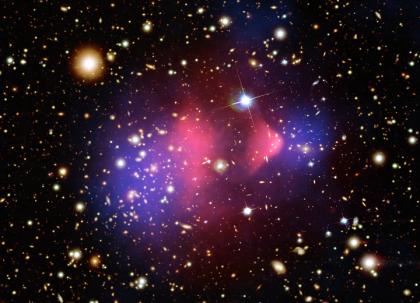
This composite image shows the galaxy cluster 1E 0657-56, also known as the "bullet cluster." This cluster was formed after the collision of two large clusters of galaxies, the most energetic event known in the universe since the Big Bang.

Lensing Illustration
Gravitational Lensing Explanation
Hot gas detected by Chandra in X-rays is seen as two pink clumps in the image and contains most of the "normal," or baryonic, matter in the two clusters. The bullet-shaped clump on the right is the hot gas from one cluster, which passed through the hot gas from the other larger cluster during the collision. An optical image from Magellan and the Hubble Space Telescope shows the galaxies in orange and white. The blue areas in this image show where astronomers find most of the mass in the clusters. The concentration of mass is determined using the effect of so-called gravitational lensing, where light from the distant objects is distorted by intervening matter. Most of the matter in the clusters (blue) is clearly separate from the normal matter (pink), giving direct evidence that nearly all of the matter in the clusters is dark.

Animation of Cluster Collision
The hot gas in each cluster was slowed by a drag force, similar to air resistance, during the collision. In contrast, the dark matter was not slowed by the impact because it does not interact directly with itself or the gas except through gravity. Therefore, during the collision the dark matter clumps from the two clusters moved ahead of the hot gas, producing the separation of the dark and normal matter seen in the image. If hot gas was the most massive component in the clusters, as proposed by alternative theories of gravity, such an effect would not be seen. Instead, this result shows that dark matter is required.

Fast Facts for 1E 0657-56:
Credit  X-ray: NASA/CXC/CfA/M.Markevitch et al.; Optical: NASA/STScI; Magellan/U.Arizona/D.Clowe et al.; Lensing Map: NASA/STScI; ESO WFI; Magellan/U.Arizona/D.Clowe et al.
Scale  Image is 7.5 x 5.4 arcmin
Category  Groups & Clusters of Galaxies
Coordinates (J2000)  RA 06h 58m 19.85s | Dec -55º 56' 29.40"
Constellation  Carina
Observation Dates  2004: Aug 10, 11, 14, 15, 17, 19, 24, 25
Observation Time  140 hours
Obs. IDs  5355-58, 5361, 4984-86
Color Code  Energy (X-ray: Pink; Optical: White/Orange; Lensing Map: Blue)
Instrument  ACIS
Also Known As The Bullet Cluster
Distance Estimate  About 3.8 billion light years
Release Date  August 21, 2006

More Information on 1E 0657-56:
Press Room: 1E 0657-56 Press Release
More Images of 1E 0657-56
1E 0657-56 Animations
1E 0657-56 Handout: html | pdf
Zoom in on 1E 0657-56 (flash)
Chandra Chronicles: Bedeviling Devil's Advocate Cosmology
Q&A: Astrophysicist Maxim Markevitch on Dark Matter
Powerpoint and PDF
Download image for your desktop
Other Chandra Releases for 1E 0657-56:
Photo Album: 1E 0657-56 (20 Feb 02)
Related Chandra Images:
Photo Album: Abell 2029 (11 Jun 03)
Photo Album: NGC 720 (22 Oct 02)
Photo Album: EMSS 1358+6245 (06 Sep 01)
More Information on Groups & Clusters of Galaxies:
X-ray Astronomy Field Guide: Groups & Clusters of Galaxies
Questions and Answers: Groups & Clusters of Galaxies
Chandra Images: Groups & Clusters of Galaxies


Chandra Images: '08 | ' 07 | ' 06 | ' 05 | ' 04 | ' 03 | ' 02 | ' 01 | ' 00 | ' 99 | Images by Category


separator line
CXC Home | Search | Help | Site Map | Image Use Policy | Privacy & Accessibility | Downloads & Plugins
Latest Images | New & Noteworthy | Multimedia | Flash Ecards | Glossary | Q&A | Guestbook


RSS Feed RSS Feed | Podcast Podcast | Blog Blog

[News by email: Chandra Digest]
[Contact us: cxcpub@cfa.harvard.edu]
NASA's Home Page Smithsonian's Home Page CXC Home Page Image Map for NASA's, Smithsonian and Chandra's Home Pages
Harvard-Smithsonian Center for Astrophysics
60 Garden Street, Cambridge, MA 02138 USA
Phone: 617.496.7941 Fax: 617.495.7356


Text Size:
normal font large font larger font
Chandra X-ray Center, Operated for NASA by the Smithsonian Astrophysical Observatory
This site was developed with funding from NASA under Contract NAS8-03060.
Revised: November 20, 2007