





CXC Home | Search | Help | Image Use Policy | Latest Images | Privacy | Accessibility | Glossary | Q&A
Download Image
More Information
More Images
Related Images


SN 1970G:
A Supernova in Progress

Credit: X-ray: NASA/CXC/GFSC/S.Immler & K.Kuntz; Optical: NOAO/AURA/NSF/G.Jacoby, B.Bohannan & M.Hanna

A Supernova in Progress
Credit: X-ray: NASA/CXC/GFSC/S.Immler & K.Kuntz; Optical: NOAO/AURA/NSF/G.Jacoby, B.Bohannan & M.Hanna
Visual Description:
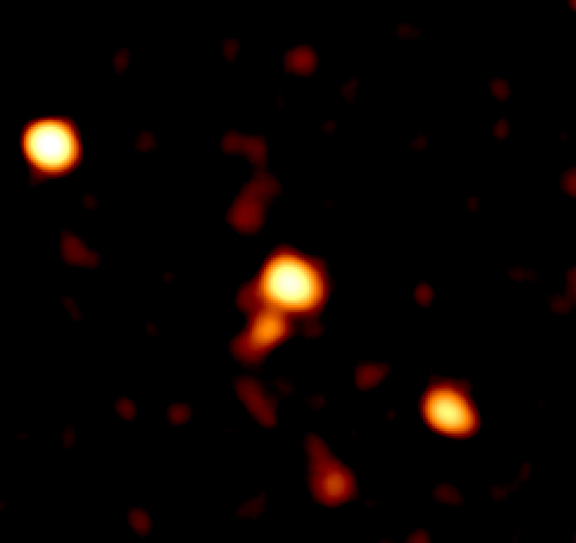
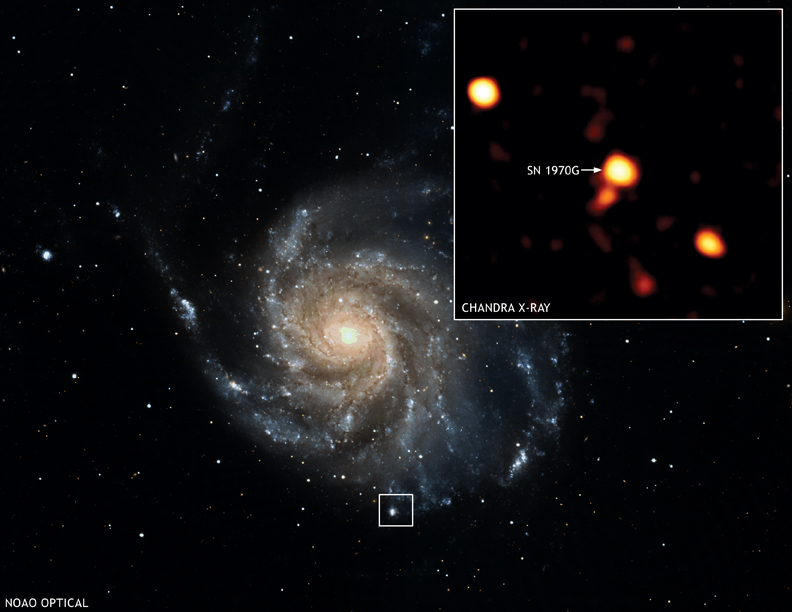
The Chandra image in the inset shows X-rays from SN 1970G, a supernova that was observed to occur in the galaxy M101 35 years ago. The bright cloud in the box in the optical image is not related to the supernova, which is located immediately to the upper right (arrow) of the cloud.
Before a massive star explodes as a supernova, it loses gas in a stellar wind that can last tens to hundreds of thousands of years, and creates a circumstellar gas shell around the star. The explosion generates shock waves that rush through this gas and heat it to millions of degrees. The X-rays from SN 1970G are likely due to this process.
By studying the spectrum and intensity of the X-rays from a supernova in the years after the explosion, astronomers can deduce information about the behavior of the star before it exploded. The observations of SN 1970G indicate that the progenitor star created its circumstellar shell by losing about one sun's worth of gas over a period of about 25,000 years before the explosion.
Astronomers estimate that in another 20 to 60 years the shock waves will have traversed the shell and encountered the interstellar medium. At this time SN 1970G will make the transition to the supernova remnant phase of its evolution.
|
||||||||||||||||||||||||||||
Visual Description:
The image is a face-on view of a spiral galaxy called M101, which features a supernova named SN 1970G towards the very bottom of one of the spiral arms. The galaxy is in the center of the image and is dominated by shades of blue-grey, pale yellow, and white, all on a black background. The shape of the galaxy is much like a pinwheel. The orange colored Chandra X-ray Observatory image in the inset shows an X-ray close-up of SN 1970G. It is a supernova that was observed to occur in the galaxy M101 over 35 years ago. The bright cloud in the box in the optical image is not related to the supernova, which is located immediately to the upper right of the cloud.


Revised: September 11, 2025