




CXC Home | Search | Help | Image Use Policy | Latest Images | Privacy | Accessibility | Glossary | Q&A
Download Image
More Information
More Images
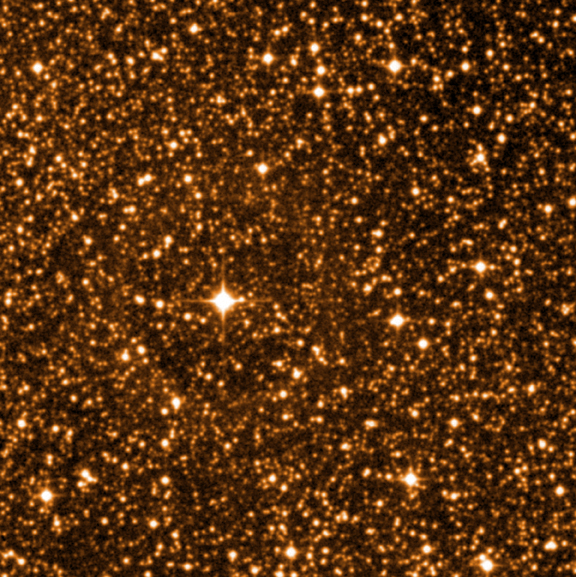
DSS Infrared Image of Proxima Centauri
(Credit: Digitized Sky Survey U.K. Schmidt Image/STScI)
Related Images
Proxima Centauri:
The Nearest Star to the Sun

The Nearest Star to the Sun
Chandra and XMM-Newton observations of the red dwarf star Proxima Centauri have shown that its surface is in a state of turmoil. Flares, or explosive outbursts, occur almost continually. This behavior can be traced to Proxima Centauri's low mass, about a tenth that of the Sun. In the cores of low mass stars, nuclear fusion reactions that convert hydrogen to helium proceed very slowly, and create a turbulent, convective motion throughout their interiors. This motion stores up magnetic energy which is often released explosively in the star's upper atmosphere where it produces flares in X-rays and other forms of light.
The same process produces X-rays on the Sun, but the magnetic energy is released in a less explosive manner through heating loops of gas, with occasional flares. The difference is due to the size of the convection zone, which in a more massive star such as the Sun, is smaller and closer to its surface.
Red dwarfs are the most common type of star. They have masses between about 8% and 50% of the mass of the Sun. Though they are much dimmer than the Sun, they will shine for much longer - trillions of years in the case of Proxima Centauri, compared to the estimated 10 billion-year lifetime of the Sun.
X-rays from Proxima Centauri are consistent with a point-like source. The extended X-ray glow is an instrumental effect. The nature of the two dots above the image is unknown - they could be background sources.
|
||||||||||||||||||||||||||||
Visual Description:
An X-ray observation of a red dwarf star, Proxima Centauri, is displayed in the image. The image features a black background with a large orange, yellow and white source at the center, and two small orange dots above it, almost like an alien with two eyes floating above its face. Proxima Centauri is a red dwarf star located in the constellation Centaurus, about 4.24 light-years away from Earth. It is one of the closest stars to our planet, making it an important target for astronomical study. Chandra as well as XMM-Newton observations (not pictured) of the red dwarf star Proxima Centauri have shown that its surface is in a state of turmoil. Flares, or explosive outbursts, occur almost continually. This behavior can be traced to Proxima Centauri's low mass, about a tenth that of the Sun. In the cores of low mass stars, nuclear fusion reactions that convert hydrogen to helium proceed very slowly, and create a turbulent, convective motion throughout their interiors. This motion stores up magnetic energy which is often released explosively in the star's upper atmosphere where it produces flares in X-rays and other forms of light.


Revised: September 08, 2025