



CXC Home | Search | Help | Image Use Policy | Latest Images | Privacy | Accessibility | Glossary | Q&A
1
VLA Radio Image of the Mouse, Full Field
The Mouse, a.k.a. G359.23-0.82, was discovered in 1987 by radio astronomers using the National Science Foundation's Very Large Array in New Mexico. It gets its name from its appearance in radio images that show a compact snout, a bulbous body, and a remarkable long, narrow, tail that extends for about 55 light years.
Scale: Image is about 16 arcmin across
(Credit: NRAO/AUI/NSF)
The Mouse, a.k.a. G359.23-0.82, was discovered in 1987 by radio astronomers using the National Science Foundation's Very Large Array in New Mexico. It gets its name from its appearance in radio images that show a compact snout, a bulbous body, and a remarkable long, narrow, tail that extends for about 55 light years.
Scale: Image is about 16 arcmin across
(Credit: NRAO/AUI/NSF)
2
Illustration of the Mouse System
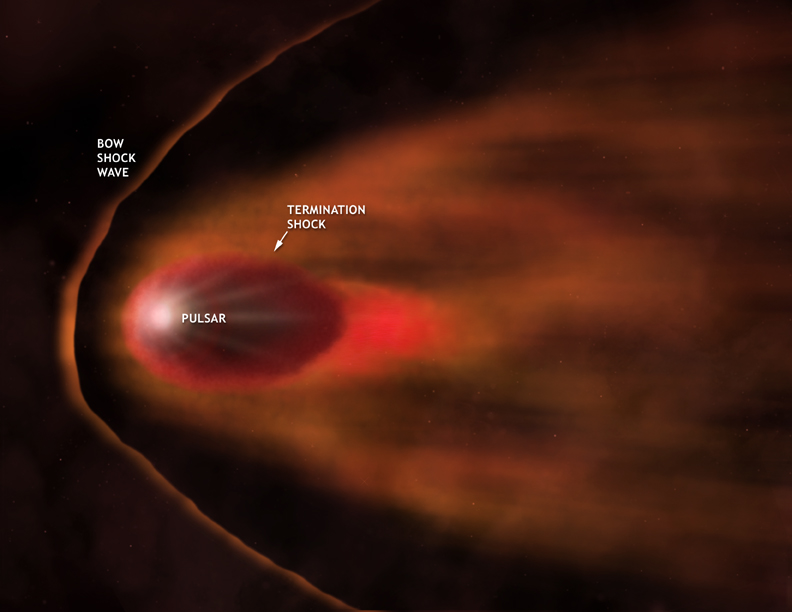
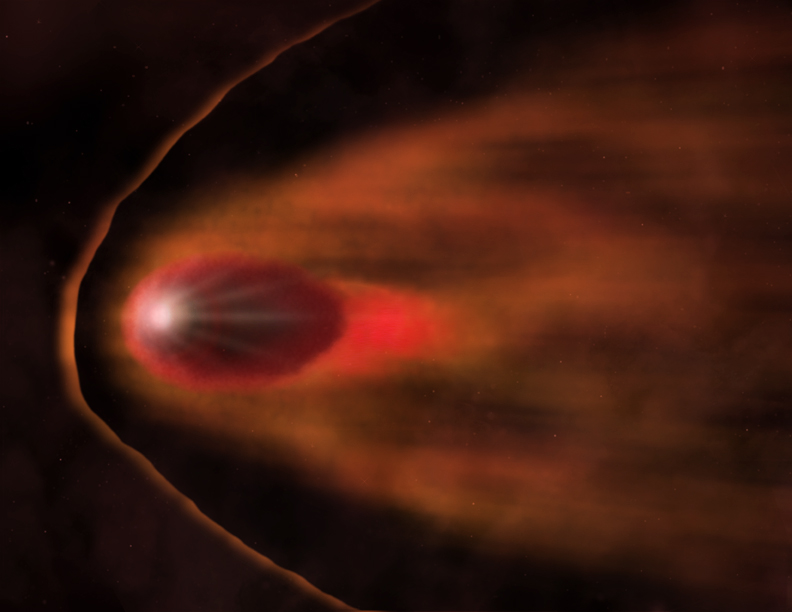
This illustration shows the various zones around a pulsar (bright white dot) that is producing a wind of high energy particles as it moves supersonically through the interstellar medium. Immediately surrounding the pulsar is a cavity (shown in red) in which the wind flows freely outward. At the point where the pressure of the pulsar wind is balanced by external pressure, a termination shock is formed. Due to the pulsar's motion, this shock has a swept back, ellipsoidal shape. The acceleration of particles at the termination shock produces a bright arc, ring or ellipsoid, depending on the viewing angle and the motion of the pulsar. Beyond the termination shock the particles stream away to form a much larger cloud that is also swept back by the interaction with the interstellar gas. The large arc in front of the pulsar is the bow shock wave that races ahead of the pulsar into the interstellar gas.
(Illustration: CXC/M. Weiss)
More Illustrations of Neutron Stars
This illustration shows the various zones around a pulsar (bright white dot) that is producing a wind of high energy particles as it moves supersonically through the interstellar medium. Immediately surrounding the pulsar is a cavity (shown in red) in which the wind flows freely outward. At the point where the pressure of the pulsar wind is balanced by external pressure, a termination shock is formed. Due to the pulsar's motion, this shock has a swept back, ellipsoidal shape. The acceleration of particles at the termination shock produces a bright arc, ring or ellipsoid, depending on the viewing angle and the motion of the pulsar. Beyond the termination shock the particles stream away to form a much larger cloud that is also swept back by the interaction with the interstellar gas. The large arc in front of the pulsar is the bow shock wave that races ahead of the pulsar into the interstellar gas.
(Illustration: CXC/M. Weiss)
More Illustrations of Neutron Stars
3
Chandra X-ray & VLA Radio Composite of the Mouse
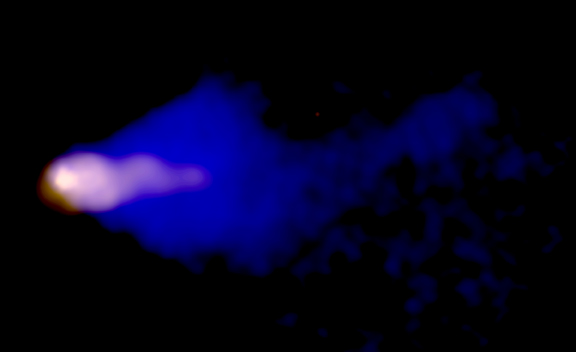
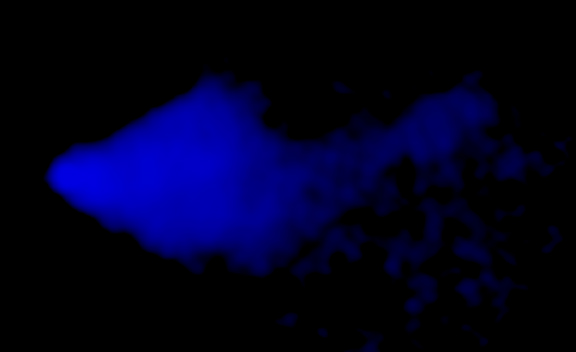
This composite image (X-ray in gold and radio in blue) shows a close-up of the head of the Mouse where a shock wave has formed as a young pulsar plows through interstellar space. Clouds of high-energy particles are swept back from the Mouse as it plows through the interstellar gas. A bright X-ray source marks the location of the pulsar, estimated to be moving through space at about 1.3 million miles per hour.
Scale: Image is about 2.5 x 1.5 arcmin
(Credit: X-ray: NASA/CXC/SAO/B.Gaensler et al.; Radio: NRAO/AUI/NSF)
This composite image (X-ray in gold and radio in blue) shows a close-up of the head of the Mouse where a shock wave has formed as a young pulsar plows through interstellar space. Clouds of high-energy particles are swept back from the Mouse as it plows through the interstellar gas. A bright X-ray source marks the location of the pulsar, estimated to be moving through space at about 1.3 million miles per hour.
Scale: Image is about 2.5 x 1.5 arcmin
(Credit: X-ray: NASA/CXC/SAO/B.Gaensler et al.; Radio: NRAO/AUI/NSF)
4
Chandra X-ray Image of the Mouse, Detail
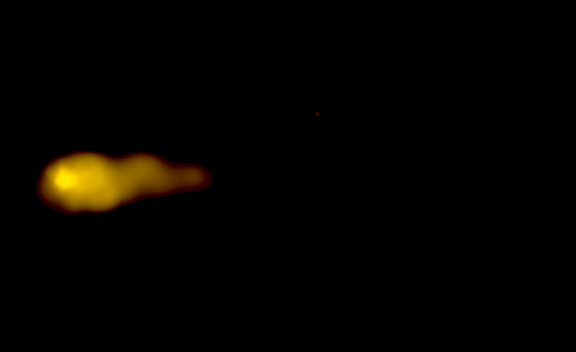
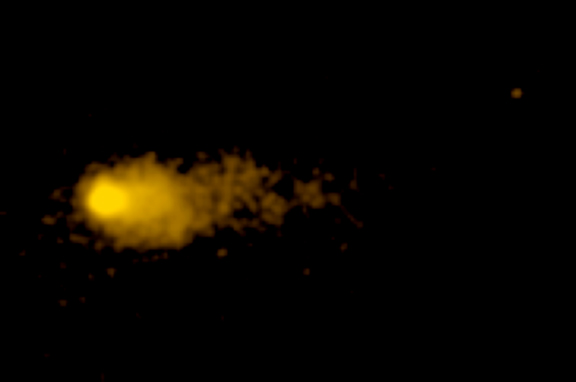
Astronomers have used data from Chandra to make the first detailed study of the behavior of high-energy particles around a fast moving pulsar. The results show a shock wave created as a pulsar plows supersonically through interstellar space. These results will provide insight into theories for the production of powerful winds of matter and antimatter by pulsars.
Scale: Image is about 1.5 x 1 arcmin
(Credit: NASA/CXC/SAO/B.Gaensler et al.)
Astronomers have used data from Chandra to make the first detailed study of the behavior of high-energy particles around a fast moving pulsar. The results show a shock wave created as a pulsar plows supersonically through interstellar space. These results will provide insight into theories for the production of powerful winds of matter and antimatter by pulsars.
Scale: Image is about 1.5 x 1 arcmin
(Credit: NASA/CXC/SAO/B.Gaensler et al.)
5
Chandra X-ray Image of the Mouse, 3-color
Chandra's image shows a close-up of the head of the Mouse where a shock wave has formed as a young pulsar plows through interstellar space. In this 3-color X-ray image red, green and blue represent increasing energy ranges.
Scale: Image is about 1.5 arcmin per side
(Credit: NASA/CXC/SAO/B.Gaensler et al.)
Chandra's image shows a close-up of the head of the Mouse where a shock wave has formed as a young pulsar plows through interstellar space. In this 3-color X-ray image red, green and blue represent increasing energy ranges.
Scale: Image is about 1.5 arcmin per side
(Credit: NASA/CXC/SAO/B.Gaensler et al.)
6
Chandra X-ray Image with Scale Bar
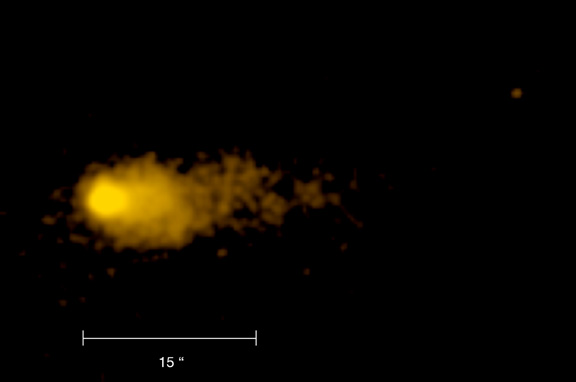
Scalebar = 15 arcsec
(Credit: NASA/CXC/SAO/B.Gaensler et al.)
Scalebar = 15 arcsec
(Credit: NASA/CXC/SAO/B.Gaensler et al.)
Return to The Mouse (23 Sep 04)


Revised: May 17, 2022