


CXC Home | Search | Help | Image Use Policy | Latest Images | Privacy | Accessibility | Glossary | Q&A
1
Hubble Space Telescope Image of the
Planetary Nebula BD+30 3639
The Hubble Space Telescope Image of BD+30 3639 shows a ring of gas at 30,000 degrees Celsius. This ring was ejected by a dying red giant star, and is now heated by ultraviolet radiation from the central star.
Scale: Image is 6.6 arcsec on a side. (1 arcsec = 230 billion kilometers at a distance of 5000 light years.)
(Credit: NASA/J.Harrington et al.)
The Hubble Space Telescope Image of BD+30 3639 shows a ring of gas at 30,000 degrees Celsius. This ring was ejected by a dying red giant star, and is now heated by ultraviolet radiation from the central star.
Scale: Image is 6.6 arcsec on a side. (1 arcsec = 230 billion kilometers at a distance of 5000 light years.)
(Credit: NASA/J.Harrington et al.)
2
Infrared Image of the Planetary
Nebula BD+30 3639
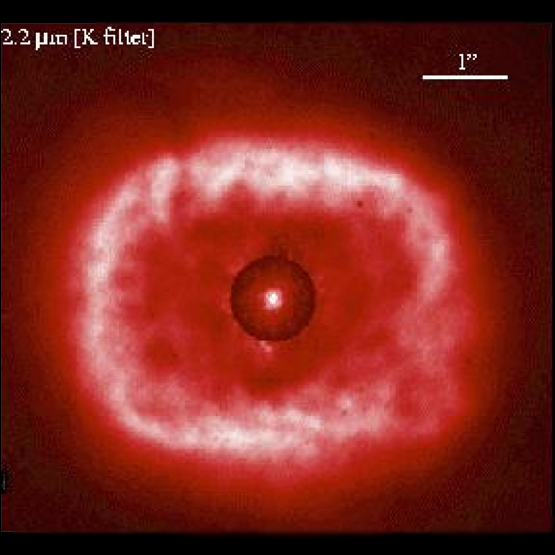
This infrared image at a wavelength of 2.2 microns shows radiation from dust grains at a temperature of -170 degrees Celsius. The dark red ring in the center of the image is an instrumental artifact.
Scale: Image is 6.6 arcsec on a side. (1 arcsec = 230 billion kilometers at a distance of 5000 light years.)
(Credit:UH/IoA/Gemini)
This infrared image at a wavelength of 2.2 microns shows radiation from dust grains at a temperature of -170 degrees Celsius. The dark red ring in the center of the image is an instrumental artifact.
Scale: Image is 6.6 arcsec on a side. (1 arcsec = 230 billion kilometers at a distance of 5000 light years.)
(Credit:UH/IoA/Gemini)
3
Optical-X-ray Comparison of
Planetary Nebula BD+30 3639
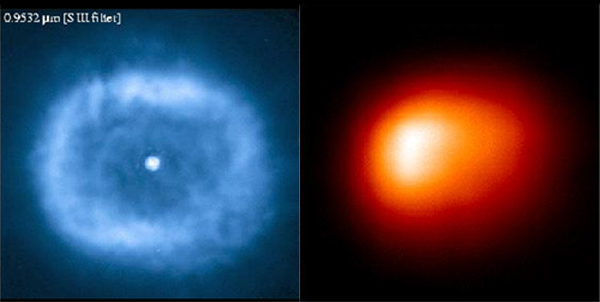
The hot gas cloud seen in the X-ray image (at right) fits inside the rim of cooler gas seen in the optical image.
(Credit: X-ray: NASA/RIT/J.Kastner et al.; Optical: NASA/J.Harrington et al.)
The hot gas cloud seen in the X-ray image (at right) fits inside the rim of cooler gas seen in the optical image.
(Credit: X-ray: NASA/RIT/J.Kastner et al.; Optical: NASA/J.Harrington et al.)
4
Optical/Infrared/X-ray comparison
for the planetary nebula BD+30 3639
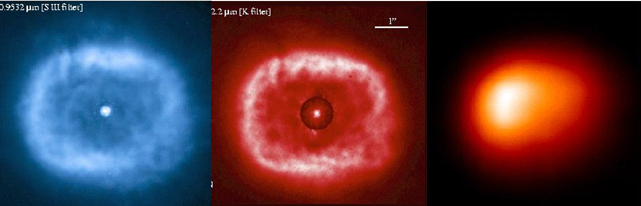
The planetary nebula was formed when a ring of gas and dust was ejected by a dying red giant star about a thousand years ago. The optical (left) shows gas in the ring that has been heated to 30,000 degrees Celsius that has been heated by ultraviolet radiation from the central star. The infrared image (middle) shows radiation from dust grains at a temperature of -170 degrees Celsius. The Chandra X-ray image (right) shows a 3 million degree Celsius cloud that appears to fit inside the rim of gas and dust seen in the optical and infrared images.
(Credits: optical: NASA/J.Harrington et al.; infrared: UH/IoA/Gemini; X-ray: NASA/RIT/J.Kastner et al.)
The planetary nebula was formed when a ring of gas and dust was ejected by a dying red giant star about a thousand years ago. The optical (left) shows gas in the ring that has been heated to 30,000 degrees Celsius that has been heated by ultraviolet radiation from the central star. The infrared image (middle) shows radiation from dust grains at a temperature of -170 degrees Celsius. The Chandra X-ray image (right) shows a 3 million degree Celsius cloud that appears to fit inside the rim of gas and dust seen in the optical and infrared images.
(Credits: optical: NASA/J.Harrington et al.; infrared: UH/IoA/Gemini; X-ray: NASA/RIT/J.Kastner et al.)
5
Chandra X-ray Image with Scale
Bar
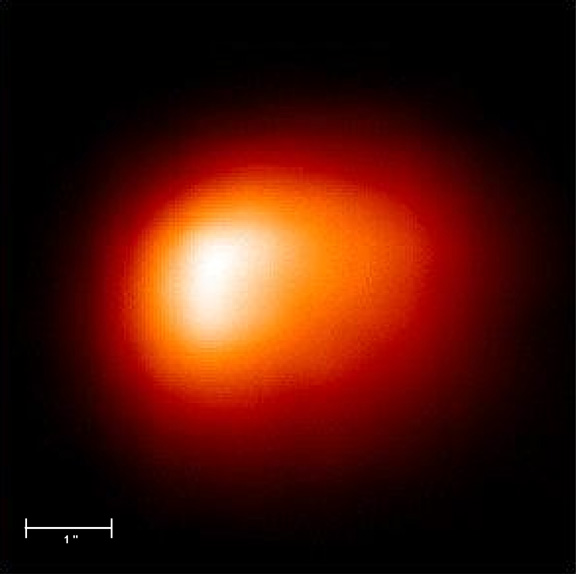
Scale bar = 1 arcsec
(Credits: NASA/RIT/J.Kastner et al.)
Scale bar = 1 arcsec
(Credits: NASA/RIT/J.Kastner et al.)
Return to PNE BD+30 (06 Jun 00)


Revised: July 08, 2008