



CXC Home | Search | Help | Image Use Policy | Latest Images | Privacy | Accessibility | Glossary | Q&A
Download Image
More Information
More Images
Hubble Space Telescope Image of the Planetary Nebula BD+30 3639
(Credit: NASA/J.Harrington et al.)
More Releases

Related Images
BD+30-3639:
Chandra Discovers Elusive "Hot Bubble" in Planetary Nebula

Chandra Discovers Elusive "Hot Bubble" in Planetary Nebula
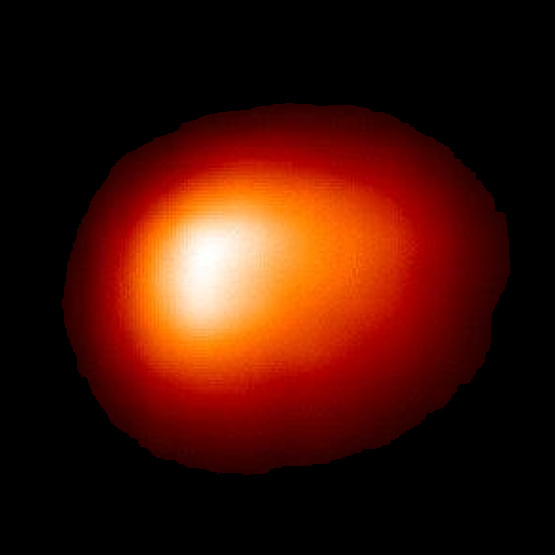
X-ray image of the Planetary Nebula BD+30 3639. The Chandra image shows a hot bubble of 3 million degree Celsius gas surrounding a dying, Sun-like star that is about 5000 light years from Earth. The distance across the bubble is roughly 100 times the diameter of our solar system.
A planetary nebula (so called because it looks like a planet when viewed with a small telescope) is formed when a dying red giant star puffs off its outer layer, leaving behind a hot core that will eventually collapse to form a dense star called a white dwarf. According to theory, a "hot bubble" is formed when a new, two million mile per hour wind emanating from the hot core rams into the ejected atmosphere and heats the interaction region to temperatures of millions of degrees. We are seeing the nebula about a thousand years after it formed.
|
||||||||||||||||||||||||||||||
Visual Description:
This is a Chandra X-ray Observatory image of a planetary nebula named BD+30 3639. This image is dominated by orange and black colors, with the lightest orange colors representing the brightest part of the nebula. Planetary nebulae are a type of celestial object that form when a Sun-like star dies and its outer layers are ejected into space. BD+30 3639 is a bright planetary nebula in the sky, making it a popular target for astrophysicists to study. The image captures the high-energy parts of the nebula's structure, which resembles a brightly glowing, irregularly shaped gas cloud. The image is a hot bubble of 3 million degree Celsius gas surrounding the dying star about 5000 light years from Earth. The distance across the bubble is roughly 100 times the diameter of our solar system.


Revised: September 10, 2025