

CXC Home | Search | Help | Image Use Policy | Latest Images | Privacy | Accessibility | Glossary | Q&A
Cen A (NGC 5128) in Context
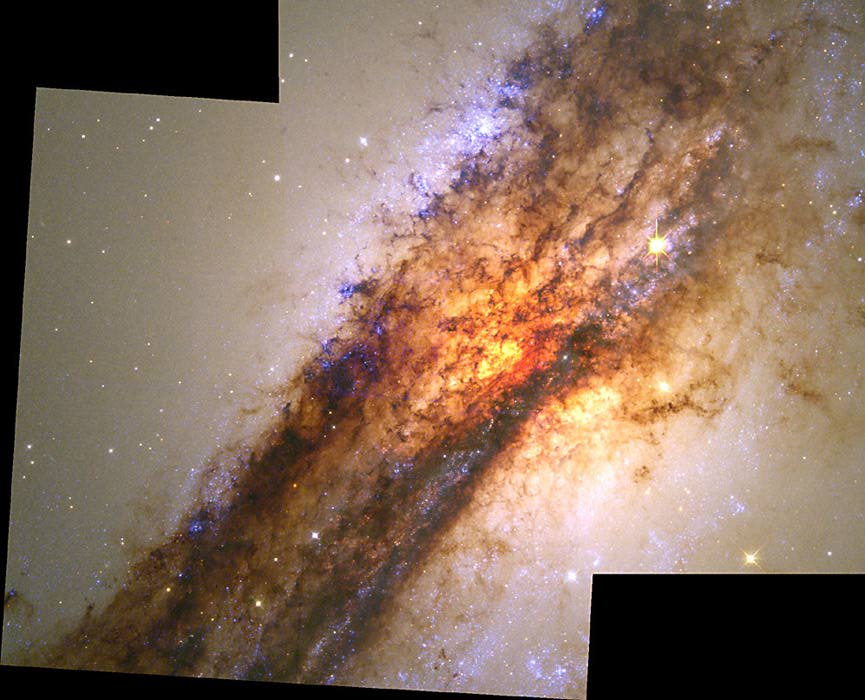 HST image of center of Cen A HST image of center of Cen ANASA/HST/E. Schreier |
In extreme cases, called quasars, an AGN can be a thousand times brighter than the host galaxy. The output from the Cen A AGN is slightly less than that of the entire host galaxy, so it is considered a relatively weak AGN. However, it is much closer to us than any quasar, so it is special.
The source of this central explosive activity is thought to be a supermassive black hole with the mass of many millions of stars. X-rays from AGN's are produced when infalling matter is heated to temperatures of millions of degrees as it approaches the gravitational event horizon. X-ray and gamma-ray observatories provide close-up view of the extreme conditions surrounding supermassive black holes.
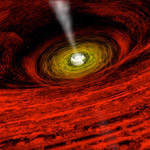 Schematic of
Supermassive Black Hole with Jet Schematic of
Supermassive Black Hole with JetNASA/CXC/SAO |
The energy radiated by a supermassive black hole can be stupendous as it gobbles up stars. The power of an AGN depends on the mass of the central black hole and the rate at which it swallows or accretes matter. One explanation for the explosive activity of Cen A's central black hole is that a collision with one or more smaller galaxies has provided a generous supply of gas for the supermassive black hole to accrete. The dust lanes seen in optical images that stretch across the middle of the galaxy may be a remnant of such a collision.
 X-ray/Optical composite of Cen A X-ray/Optical composite of Cen ANASA/CXC/SAO /AURA/NOAO/NSF |
One of the most intriguing features of supermassive black holes is that they do not suck up ALL the matter that falls within their sphere of influence. Some of the matter falls inexorably toward the black hole, and some explodes away from the black hole in high-energy jets that move at near the speed of light. The X-ray jets in Chandra's image of Cen A extend from the center of the galaxy, out to a distance of more than 15,000 light years.
The presence of a bright X-ray jet means that magnetic fields are continually accelerating electrons to extremely high energies over enormous distances. Exactly how this happens is a major puzzle that Chandra may help to solve.
Return to Centaurus A (25 Oct 99)


Revised: May 17, 2022