

CXC Home | Search | Help | Image Use Policy | Latest Images | Privacy | Accessibility | Glossary | Q&A
Image Interpretation
For the activity, the students will develop an image of Cassiopeia A (Cas A), the first astronomical object detected by the Chandra X-ray Observatory. The following information provides more information on Cas A obtained from the Chandra web site (http://chandra.harvard.edu/photo/0237/index.html).
In 1680, the British astronomer John Flamsteed observed a bright star that was never seen again. Evidence indicates that this bright star was the explosion that produced Cas A. The Chandra image below shows the 320-year-old remnant of a massive star that exploded to form the supernova remnant Cas A. Located in the constellation Cassiopeia, it is 10 light years across and 10,000 light years from Earth. The observed expansion rate and the observed size of the supernova remnant, give an estimate of the age of about 320 years, near the same time that Flamsteed observed the bright star. The distance to Cas A is approximately 10,000 light years, so the explosion really just over 10,000 years ago. When astronomers talk about such events, they are more interested in the age of the remnant as we see it, which is important for understanding its evolution. They take for granted that the actual event occurred earlier because of light travel time.
The instrument that collected the data for this image is the advanced charge-coupled device (CCD), which uses electronic equipment to detect photons. The Advanced CCD is composed of many tiny electronic cells, each of which records a buildup of charge to measure the amount of X-ray radiation striking it. The image below was made with the Advanced CCD with a 5000 second exposure time on August 19, 1999. More information on the Advanced CCD can be found at http://chandra.harvard.edu/about/science_instruments.html.
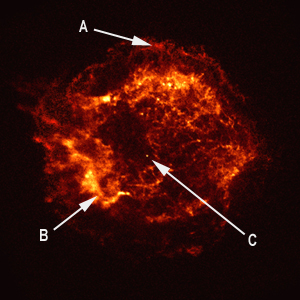
In the image, two shock waves are visible: a fast outer shock (Arrow A) and a slower inner shock (Arrow B). The inner shock wave is believed to be due to the collision of the ejecta from the supernova explosion with a circumstellar shell of material, heating it to a temperature of ten million degrees. The outer shock wave is analogous to an awesome sonic boom resulting from this collision. The small bright object near the center (Arrow C) may be the long sought neutron star or black hole that remained after the explosion that produced Cas A
This false color image of Cas A shows the brightness of the X-rays, where yellow reveals the areas with the most intense X-ray emission.


Revised: August 24, 2017