Cassiopeia A Composite Image Gallery
This page can be used in conjunction with any of the investigations, tasks, or
activities in this section which ask students to compare and contrast images of
an object in different wavelengths. These include the CAS Timeline investigation,
and the perfomance tasks "Signals from the Cosmos", "Point of View", "The universe Rated R!", and "Portrait Gallery of the X-Ray Universe".
Cassiopeia A, or Cas A is the remnant of a massive star that exploded around
three hundred years ago. These images show Cas A as viewed by four different
types of telescopes.
You can view composited images by selecting the combinations you would like to
see from the pull down menu on the right and then clicking the "Get Composite"
button.
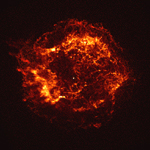
Cas A in the X-ray range of the
spectrum.The X-ray image shows an expanding shell of hot gas produced by
the explosion. This gaseous shell is about 10 light years in diameter, and has a
temperature of about 50 million degrees.
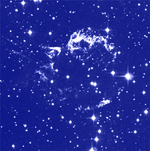
Cas A in the optical range of the
spectrum. The optical image of Cas A shows matter with a temperature of
about ten thousand degrees. Some of these wisps contain high concentrations of
heavy elements and are thought to be dense clumps of ejected stellar material.
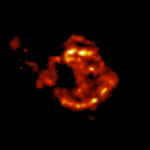
Cas A in the infrared range of the
spectrum. The infrared image of Cas A shows dust grains that have been
swept up and heated to several hundred degrees by the expanding hot gas. It is
not known whether the dust grains were ejected by the star millions of years
before it exploded or during the explosion.
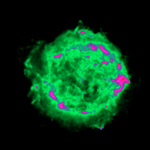
Cas A in the radio range of the
spectrum. Cas A gets its name from radio astronomers, who 'rediscovered'
it in 1948 as the strongest radio source in the constellation of Cassiopeia.
About 5 years later optical astronomers found the faint wisps, and it was
determined that Cas A is the remnant of an explosion that occurred about 300
years ago. The radio emission comes from high-energy electrons moving in large
spirals around magnetic field
Cas A Overlays |
Cas A Timeline Activity |
Cas A Photo Album