An overview of the Chandra mission and goals, Chandra's namesake, top 10 facts.
Classroom activities, printable materials, interactive games & more.
Overview of X-ray Astronomy and X-ray sources: black holes to galaxy clusters.
All Chandra images released to the public listed by date & by category
Current Chandra press releases, status reports, interviews & biographies.
A collection of multimedia, illustrations & animations, a glossary, FAQ & more.
A collection of illustrations, animations and video.
Chandra discoveries in an audio/video format.
Disclaimer: This material is being kept online for historical purposes. Though accurate at the time of publication, it is no longer being updated. The page may contain broken links or outdated information, and parts may not function in current web browsers. Visit chandra.si.edu for current information.
Chandra People: Behind the Scenes
April 26, 2000 ::
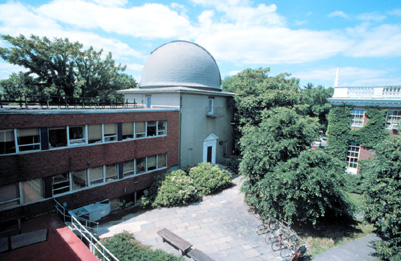
The Chandra X-ray Center provides researchers with support that includes data processing and a science data archive. The Center is operated for NASA by the Smithsonian
Astrophysical Observatory and is situated on the campus of Harvard University.
|
Now that Chandra has moved into the science operations phase, we have asked some people working at the Chandra X-ray Center to answer a brief
questionnaire. The questions are designed to give examples of the work being done at the Center, and to provide some insight into how people feel about their work. Responses will be presented in the
Chronicle during the coming weeks. Today, we look at astrophysicist Scott Wolk and his wife Nancy R. A. Wolk, a computer specialist/programmer.
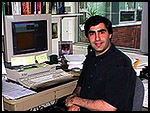
Scott Wolk |
Scott Wolk
Q: What are your areas of research interest (i.e. stars, black holes, galaxies, clusters)?
A: Star Formation in young clusters: Especially the time scales for disk dissipation (this tells us how long gas giant planets have to form around a young star.) and
the characteristics of brown dwarfs (this tells us if there is a fundamental difference between how stars and giant planets form.)
Q: Are you using Chandra images in your research?
A:Yes.
Q: Which images?
A: M7 ( the beehive cluster), M42 (The Great nebula in Orion) and NGC 2516 (The southern Pleiades.)
Q: How are these images changing your particular area of research?
A: Most of the images are very new to us, so we haven't uncovered all that is hidden in them.
The M7 image is a very short image. While the cluster had been looked at before by other X-ray satellites, the stars are so close together, it was hard to tell which star was emitting X-Rays and
which were innocent bystanders. This image is making distinction possible and is improving our knowledge of which stars are members of the cluster and which stars just happen to appear in the same
part of the sky.
 The M42 image is a spectacular image with 1000's of individual stars clearly visible. We are
currently matching the data from Chandra with data taken from the ground to determine if we see any brown dwarfs. If we do, it would indicate that brown dwarfs are internally very much like stars. If
brown dwarfs are like stars inside, Jupiter may have been the same way. This would greatly change our ideas about the chemistry of the early solar system and how the Earth formed.
The M42 image is a spectacular image with 1000's of individual stars clearly visible. We are
currently matching the data from Chandra with data taken from the ground to determine if we see any brown dwarfs. If we do, it would indicate that brown dwarfs are internally very much like stars. If
brown dwarfs are like stars inside, Jupiter may have been the same way. This would greatly change our ideas about the chemistry of the early solar system and how the Earth formed.
The NGC2516 image is the one we have been working on the longest, about 6 months. The data seem to be leading us to a very surprising conclusion: that intermediate mass stars can emit X-rays.
Theoretically, We understand how high mass stars and low mass stars emit X-rays, and they do it in completely different ways. Intermediate mass stars are thought to be incapable of emitting X-rays.
Previous missions had found a small amount of circumstantial evidence that they do. But with Chandra's remarkable resolution we can exclude the possibility that there is another star hiding in the
glare emitting the X-rays we see.
Q: What would you suggest for future X-ray astronomy missions?
A: Any future mission should build on the capabilities of the current missions. I would like to see a telescope with imaging capability as good as Chandra's (there are
reasons that it is hard to go higher) and a greater ability to resolve small temperature (or color) variations. Such a telescope would allow us to create a three dimensional map of the hot gas around
young stars. The stars tell us about our own solar system when it was formed. The extent and amount of hot gas would enable us to better understand the origin of our own planet.
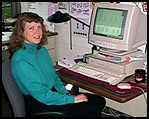
Nancy R. A. Wolk |
Nancy R. A. Wolk
Q: What are your duties at the CXC?
A: I mostly work on the standard data processing pipelines. These are a series of software tools that all data are processed through before being sent to the
observer.
Q: What did you do today?
A: I am currently working on a series of tools to create a summary page for the observer. This summary gives the observer a chance to quickly look over the data before
examining their data in detail with other CXC tools.
Q: Have you worked on other major space telescope projects?
A: No.
Q: What do you like least about your work with Chandra?
A: The worst part of the job here is answering questions that come into our help system. Sometimes the questions are from scientists needing to understand the formats of
the data we sent them. A majority of the questions are on how to use our software. These are tough to answer since each developer does not know each tool in detail. We then have to ask the person who
wrote the tool for help. The rest of the questions are about possible bugs in our software. I actually like to hear about these because it is better to get these fixed as early as possible.
Q: What do you like most about your work with Chandra?
A: The best part of working with Chandra is the ability to work with 2 things I love: programming and astronomy. I still get to work on my astronomy skills, and do a
little research when I get the chance. I am working on X-ray data for the first time (I did previous research in optical wavelengths) and my knowledge of the software system helps in the reduction of
the data.
Disclaimer: This material is being kept online for historical purposes. Though accurate at the time of publication, it is no longer being updated. The page may contain broken links or outdated information, and parts may not function in current web browsers. Visit chandra.si.edu for current information.







