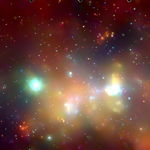
Among other things, they found fluorescence, not from the plumage of parrots, but from iron atoms in a vast cloud of gas that pervades the central region of our Galaxy. The
fluorescence occurs when high energy particles or X-rays knock electrons out of the inner parts of the iron atoms and excite the atom to a higher energy level. The atoms almost immediately return to
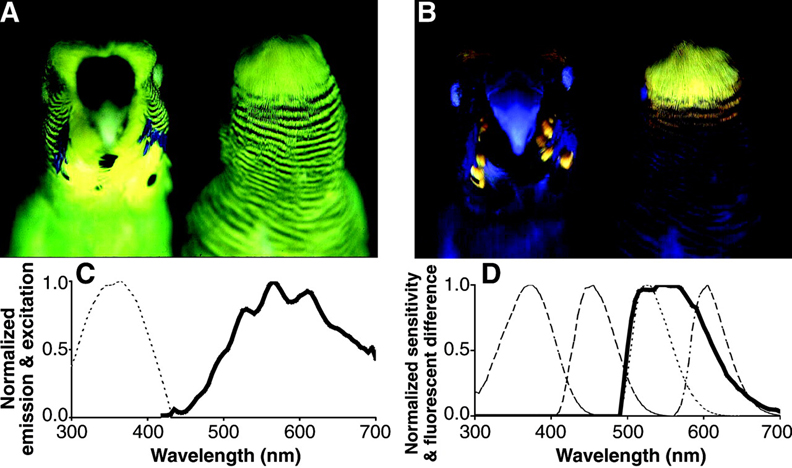
their lower energy state with the emission of a longer wavelength, fluorescent X-ray. This process is similar to the one that causes parrot plumage to fluoresce.
The origin of this Milky Way fluorescent signaling is a mystery. It is well known that the disks of gas swirling toward neutron stars and black holes produce iron fluorescence, but there are not
enough bright neutron star and black hole sources in the Galactic Center region to explain the observations. Nor is gas falling into the supermassive black hole at the center of our Galaxy producing
enough X-rays.
One possible explanation is that the center of the Galaxy was wracked by an unusually large outburst from a supernova or the supermassive black hole a few
hundred years ago. If so, fluorescent iron atoms could be sending a signal that something really big happened there in the past. Meanwhile, astronomers will continue to explore this and other
evolutionary pathways that could have led to the Milky Way's fluorescence.
Return to Chandra Chronicles
Highlights and Feature Stories from the Chandra Project
Archived reports of past Chandra Chronicles
Receive the Chandra Digest
Updated: March 27, 2008