An overview of the Chandra mission and goals, Chandra's namesake, top 10 facts.
Classroom activities, printable materials, interactive games & more.
Overview of X-ray Astronomy and X-ray sources: black holes to galaxy clusters.
All Chandra images released to the public listed by date & by category
Current Chandra press releases, status reports, interviews & biographies.
A collection of multimedia, illustrations & animations, a glossary, FAQ & more.
A collection of illustrations, animations and video.
Chandra discoveries in an audio/video format.
Disclaimer: This material is being kept online for historical purposes. Though accurate at the time of publication, it is no longer being updated. The page may contain broken links or outdated information, and parts may not function in current web browsers. Visit chandra.si.edu for current information.
Backyard Astronomers Trigger Multi-satellite Observing Campaign on SS Cygni
January 19, 2001 ::

Illustration of the Chandra X-ray Observatory (top) and Rossi X-ray Timing Explorer (bottom)
(Credit: NASA/CXC) |
Thanks to alerts from amateur astronomers in thirteen countries, the NASA satellites Chandra and RXTE made coordinated unique observations of the bright northern dwarf nova SS Cygni on
January 16 and 17. Together, the data from the satellites and the backyard observers will reveal much about the flow of gas from a small red star onto its compact, dying companion, a white dwarf.
This is the second time that Chandra has observed this eruptive variable during outburst. Read about an earlier, highly successful collaboration on SS Cygni involving AAVSO observers and NASA satellites at http://chandra.harvard.edu/chronicle/0300/aavso.html.
After dozens of amateur astronomers had kept an intense and dedicated vigil for 72 days - 22 days longer than anticipated - SS Cygni finally started to brighten on January 12. The volunteer observers immediately sent detailed reports to the Headquarters
of the American Association of Variable Star Observers (AAVSO), as had been requested by Director Dr. Janet A. Mattei, who with her technical staff is coordinating the collection of optical
observations of SS Cygni and communicating them to the Principal Investigators for the Chandra and RXTE observations.
In less than 24 hours, by January 13, the outburst of SS Cygni was confirmed - SS Cygni was definitely on the rise. Late on January 13 SS Cygni surged to near maximum optical
brightness, then reached maximum.
As the data came in from the observers by email, fax, and phone, Dr. Mattei communicated with collaborators Dr. Christopher Mauche at Lawrence Livermore National Observatory, CA, Principal Investigator (PI) for the Chandra observations, and Dr. Peter
Wheatley at the University of Leicester, England, PI for the RXTE observations, both of whom had been waiting anxiously for weeks for word from the AAVSO's observers. Once the outburst was clearly established, Dr. Mattei triggered the Chandra
Target-of-Opportunity observations (TOO) via a webform, on Sunday morning, Jan. 14, at the request of Dr. Mauche, who was skiing in Utah and had no access to a computer.
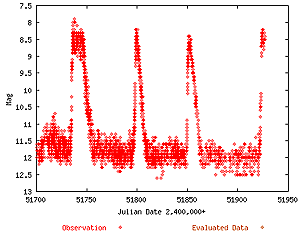
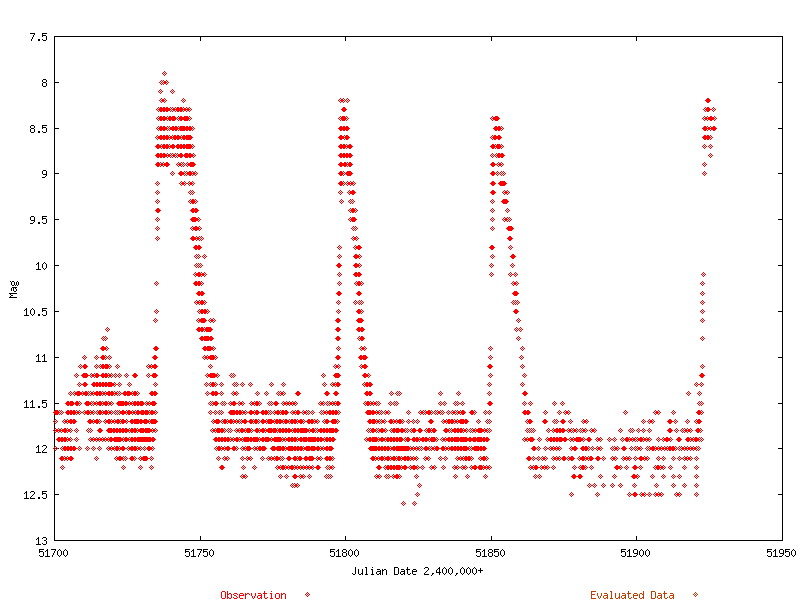
Figure 1. Light curve of SS Cygni comprised of observations of SS Cyg received at AAVSO from June 4, 2000 to January 17, 2001 (JD 2451700 - 2451927).
Click to enlarge |
Catching the outburst of SS Cygni at peak optical brightness was crucial. Previous Extreme Ultraviolet Explorer (EUVE) satellite observations demonstrate that in SS Cygni
there is a delay of 1.5 days between the rise of the optical and extreme ultraviolet/soft X-ray flux. Soft X-ray emission peaks and then stays bright for about 4 days, then declines, first slowly and then sharply. In order to acquire optimum data, it was
essential to observe SS Cygni at optical and soft X-ray peak, that is, within 4 days of reaching optical maximum.
Recognizing the urgency of this time limit, Chandra Director Dr. Harvey Tananbaum, who was informed of the TOO request triggering within half an hour, advised the Chandra planners and schedulers to see if observations of SS Cygni could be scheduled
within three days. The Chandra planners and schedulers made a Herculean effort, and Chandra observations were scheduled for January 16, 4:30 PM EST to Jan 17, 5:40 AM EST.
In the meantime, Dr. Wheatley, having been alerted by Dr. Mattei, sent a request, on Sunday, Jan. 14, to the RXTE satellite planners and schedulers for hard X-ray observations to be made simultaneously with those of Chandra. Although optimally 72 hours
are needed to schedule RXTE, the team made a tremendous effort and was able to schedule RXTE to start observing SS Cygni just a few hours after Chandra started.
What are the satellites going for in SS Cygni? The previous coordinated observations had utilized Chandra's high-energy transmission grating spectrometer (
HETGS) to study the spectrum of the hard X-rays emitted by the tenuous upper "atmosphere" of the boundary layer between the accretion disk and the surface of the white dwarf. During the current
observations, Chandra's low-energy transmission grating spectrometer (
LETGS) was used to study the spectrum and temporal characteristics of the dominant spectral component of the inner accretion disk
and boundary layer, a "big blue bump" in SS Cygni's spectrum which peaks at extreme ultraviolet/soft X-ray energies. These measurements will fill in the missing piece of the puzzle of the X-ray spectrum of SS Cygni in outburst, and will be used to study
the physics, physical development, and characteristics of the boundary layer. This information is crucial not only for understanding SS Cygni itself, but also active galactic nuclei, which also show a "big blue bump" in their spectra.
Chandra and RXTE prove a powerful combination, with Chandra pinning down the boundary layer spectrum in great detail and
RXTE simultaneously probing its
most rapid variability.
The continuing visual observations from the AAVSO volunteer observers worldwide will be essential in correlating these ground-breaking satellite observations with the optical outburst of SS Cygni, and observations are pouring in to the AAVSO daily.
Figure 1 is a light curve (graph of light variation) showing the behavior of SS Cygni from June 2000 to date. Each dot represents one optical observation.
This project is a wonderful collaboration of professional and amateur astronomers and NASA's Chandra and RXTE Directors and Operations Teams to observe the brightest dwarf nova simultaneously with NASA satellites.
The AAVSO - a scientific and educational organization - was founded in 1911 at Harvard College Observatory to coordinate variable star observations made largely by amateur astronomers. It became an independent, non-profit organization in 1954. Today,
the AAVSO has members in over 40 countries and maintains the world's largest computer-readable optical variable star database with over 10 million observations and growing by over 300,000 observations yearly. The AAVSO is headquartered in Cambridge,
Massachusetts.
-by Janet A. Mattei
For more information, refer to the AAVSO website at
http://www.aavso.org.
Disclaimer: This material is being kept online for historical purposes. Though accurate at the time of publication, it is no longer being updated. The page may contain broken links or outdated information, and parts may not function in current web browsers. Visit chandra.si.edu for current information.