
Overfed Black Holes Shut Down Galactic Star-Making
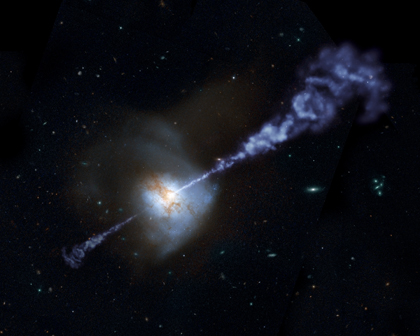
A new study has shown that galaxies with the most powerful, active, supermassive black holes at their cores produce fewer stars than galaxies with less active black holes. Researchers compared infrared readings from the Hershel Space Observatory with X-rays streaming from the active central black holes in a survey of 65 galaxies, measured by NASA's Chandra X-ray Observatory.
At lower intensities, the black holes' brightness and star formation increased in sync. However, star formation dropped off in galaxies with the most energetic central black holes. Astronomers think inflows of gas fuel new stars and supermassive black holes. Feed a black hole too much, however, and it starts spewing radiation into the galaxy that prevents raw material from coalescing into new stars.
Supermassive black holes are believed to reside in the hearts of all large galaxies. When gas falls upon these monsters, the materials are accelerated and heated around the black hole, releasing great torrents of energy. In the process, active black holes often generate colossal jets that blast out twin streams of heated matter.
More at https://chandra.harvard.edu/photo/2012/hgs/
-Megan Watzke, CXC